
LookupA searchable reference table
Turkey Roasting Time Chart: Stuffed and Unstuffed by Weight
A searchable copy of the USDA's turkey roasting timetable and safety rules: times by weight for stuffed and unstuffed birds, the temperature to reach, where to check it and how long to rest.
On this page
| Topic | Weight or detail | What FSIS says |
|---|---|---|
| Unstuffed turkey | 4 to 8 pounds (breast) | 1½ to 3¼ hours |
| Unstuffed turkey | 8 to 12 pounds | 2¾ to 3 hours |
| Unstuffed turkey | 12 to 14 pounds | 3 to 3¾ hours |
| Unstuffed turkey | 14 to 18 pounds | 3¾ to 4¼ hours |
| Unstuffed turkey | 18 to 20 pounds | 4¼ to 4½ hours |
| Unstuffed turkey | 20 to 24 pounds | 4½ to 5 hours |
| Unstuffed turkey breast | 4 to 6 pounds (breast) | 1½ to 2¼ hours |
| Unstuffed turkey breast | 6 to 8 pounds (breast) | 2¼ to 3¼ hours |
| Stuffed turkey | 4 to 6 pounds (breast) | Not usually applicable |
| Stuffed turkey | 6 to 8 pounds (breast) | 2½ to 3½ hours |
| Stuffed turkey | 8 to 12 pounds | 3 to 3½ hours |
| Stuffed turkey | 12 to 14 pounds | 3½ to 4 hours |
| Stuffed turkey | 14 to 18 pounds | 4 to 4¼ hours |
| Stuffed turkey | 18 to 20 pounds | 4¼ to 4¾ hours |
| Stuffed turkey | 20 to 24 pounds | 4¾ to 5¼ hours |
| Oven temperature | All the times above | 325 °F; set the oven no lower than that |
| Oven temperature | Roasting | Set your oven temperature no lower than 325 °F |
| Frozen turkey | Cooked from the frozen state | At least 50 percent longer than for a fully thawed turkey |
| Preheating | Roasting | Not necessary; set the oven no lower than 325 °F |
| Safe internal temperature | Whole turkey | 165 °F, as measured with a food thermometer |
| Where to check | Whole turkey | The innermost part of the thigh and wing and the thickest part of the breast |
| Where to check | Whole poultry | Three places: innermost thigh, innermost wing and thickest part of the breast, avoiding the bone |
| Safe internal temperature | Stuffing | The center of the stuffing must reach 165 °F |
| Resting time | Before carving | 20 minutes, to let the juices set |
| Resting time | Stuffed turkey | Let it stand 20 minutes before removing the stuffing and carving |
| Pop-up indicator | Turkey with a pop-up timer | Also check with a food thermometer; 165 °F is the minimum for safety |
| Color | Pink meat | Turkey can stay pink after reaching 165 F; only a food thermometer tells you it is safe |
| Color | Any cooked meat or poultry | Color is not a reliable sign; the thermometer is the only way to know |
| Stuffing advice | Stuffing in the bird | Not recommended for optimum safety; cook stuffing in a casserole |
| Stuffing amount | If you do stuff the bird | Stuff loosely, about 3/4 cup of stuffing per pound |
| Stuffing timing | If you do stuff the bird | Do not stuff a turkey the night before cooking it |
| Stuffing timing | Straight to the oven | Place the stuffed, raw turkey in an oven set no lower than 325 °F right away |
| Stuffing and the bird | Stuffing under 165 °F | Do not remove it from the turkey before 165 °F; keep cooking |
| Stuffing ingredients | Raw meat, poultry or shellfish | Precook them before stuffing |
| Leftovers | Cooked turkey and stuffing | Refrigerate within 2 hours |
| Leftovers | Reheating a cooked turkey | Reheating a whole turkey is not recommended; cut the meat into smaller pieces first |
| Leftovers | Cooked turkey and stuffing | Use within 3 to 4 days; reheat to 165 °F |
What this chart shows
This is the USDA Food Safety and Inspection Service roasting timetable for a whole turkey, copied row by row from its consumer guide, with the nearby safety rules that cooks most often ask about. Use the search box to jump to a weight, or to words such as stuffed, resting or pop-up. The timetable assumes an oven set at 325 °F and a turkey that is fully thawed. If yours is still frozen, read the thawing steps first in the Thanksgiving turkey thawing and food safety timeline.
For other birds and poultry parts, the chicken and turkey cooking times table covers sizes this chart does not. If you need to convert pounds to kilograms or an oven temperature to Celsius, Calcimator does the arithmetic; this site does not run calculators.
How to use the times
Find your bird's weight in the unstuffed or stuffed rows and read the range. Start checking at the short end of the range, because the range is wide for a reason: ovens run hot or cold, and the USDA lists many things that change the clock. A partially frozen bird, a stuffed cavity, a dark roasting pan, a lid, a roasting bag, a big pan that blocks airflow and an inaccurate oven can each move the finish time. A foil tent kept on the whole time slows browning and cooking.
The ranges also overlap between weight bands, and the USDA's own Turkey Basics page splits the smallest breast sizes more finely than the consumer guide does. Both are in the table. Treat every time as a planning tool for when to put the bird in and when to begin testing, never as proof that it is done.
Why the thermometer wins
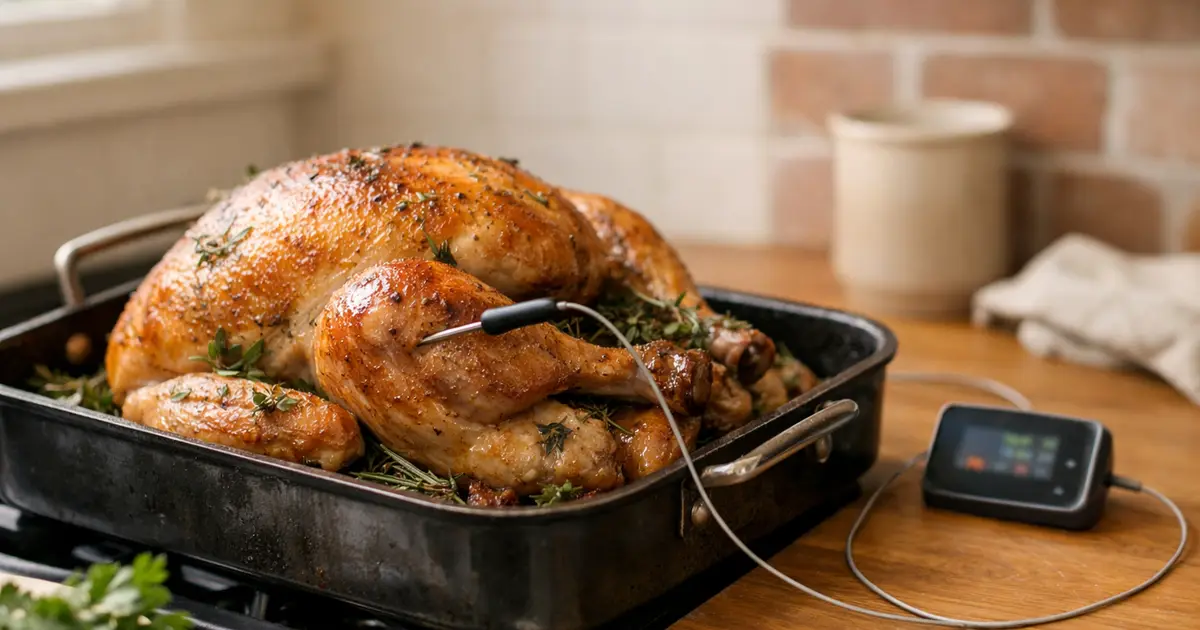
Heat has to reach the slowest-heating spot before bacteria in that spot die. In a whole bird that spot is deep in the thigh and wing, or in the thickest part of the breast, which is why the USDA names all of those places. Pushing the probe near bone gives a falsely high reading, so aim for the meat beside it. Color is a weak clue: the USDA says turkey can stay pink after reaching the safe temperature, and it notes that smoked turkey is always pink. If your bird has a pop-up indicator, the USDA recommends that you also check with a real thermometer. If you cook to a higher temperature for taste, that is your choice, but it is not needed for safety.
Stuffing: the riskier choice
The USDA does not recommend stuffing a whole turkey, because stuffing is a good place for bacteria to grow and the center can lag behind the meat. The bird may be done while the stuffing is not. Baking stuffing in a casserole cooks it evenly and takes the question away. If you do stuff the bird, fill it loosely with about 3/4 cup per pound, keep the wet and dry ingredients apart until the moment you fill the cavity, and put the bird straight into the oven. Do not stuff it the night before. Precook any raw meat, poultry or shellfish that goes into the stuffing, and keep roasting until the center of the stuffing reaches the safe temperature, even if the meat got there sooner.
Resting and leftovers
Let the cooked turkey stand for 20 minutes before carving. The USDA gives quality as the reason: the juices settle and the meat carves more easily. For a stuffed bird, wait that long before taking the stuffing out. Then get food into the refrigerator within 2 hours of cooking, in shallow containers, and use it within 3 to 4 days or freeze it. The USDA does not recommend reheating a whole turkey; cut the meat into smaller pieces first.
Worked example: a mid-sized bird for a big table
You bought a turkey in the 14 to 18 pounds band. Unstuffed, the USDA timetable gives 3¾ to 4¼ hours at 325 °F; stuffed, it gives 4 to 4¼ hours. Say you want the bird rested and ready at the moment guests sit down. Work backward: dinner time, minus the rest, minus the longest time in the range, gives the latest moment to start, and starting a little earlier leaves room for a slow oven. Begin testing at the short end. If the thigh reads safe but the breast does not, keep roasting and test again. If the bird finishes early, it can stand longer under foil while the sides catch up, still inside the window for putting leftovers away.
For comparison, a turkey cooked from the frozen state takes at least 50 percent longer than the thawed times in the table, and the giblet packages must come out partway through, with tongs. Plan about 1 pound of turkey per person when you shop, per the USDA guide for fresh and frozen birds.
When to call for help
The USDA runs a Meat and Poultry Hotline for questions about cooking a bird that this chart does not answer. If anyone has eaten turkey or stuffing that you later learn did not reach a safe temperature, contact a doctor if symptoms appear, and call sooner for a child, an older adult, a pregnant person or someone with a weakened immune system.
Sources
- USDA FSIS, Let's Talk Turkey—A Consumer Guide to Safely Roasting a Turkey fsis.usda.gov
- USDA FSIS, Turkey Basics: Safe Cooking fsis.usda.gov
- USDA FSIS, Turkey Basics: Stuffing fsis.usda.gov
- USDA FSIS, Stuffing and Food Safety fsis.usda.gov
- USDA FSIS, Your Safe Thanksgiving Guide fsis.usda.gov
- USDA FSIS, Turkey Basics: Handling Cooked Dinners fsis.usda.gov
- USDA FSIS, Is Pink Turkey Meat Safe? fsis.usda.gov
- USDA FSIS, Food Thermometers fsis.usda.gov