
GuideA plain-language guide with a worked example
How to organize your refrigerator for food safety
A refrigerator protects food only when it is cold enough. Verify the temperature with a thermometer, wrap raw meat, keep perishables off the door, cool hot food fast and clean up spills right away.
On this page
Most of us arrange a refrigerator by habit: tall bottles in the door, leftovers wherever they fit, the meat tray because it is labeled for meat. The USDA's advice is simpler and more forgiving than many people expect. The cold is what matters most, and the rest of the job is keeping raw juices, spills and warm food from undoing it. This guide walks through the whole box, from the dial to the door bins.
Why cold matters
Bacteria live in soil, air, water and food, and they multiply when they have nutrients, moisture and warmth. FSIS says they grow most rapidly between 40 °F and 140 °F, the range often called the danger zone, and that some can double in number in as little as 20 minutes. Refrigeration slows that growth. It does not stop it, and it does not kill anything.
That last point is worth sitting with. The USDA separates bacteria into a pair of families. Pathogenic bacteria cause illness but generally do not change the taste, smell or look of food, so you cannot tell they are present. Spoilage bacteria can keep growing in the cold and eventually make food smell or taste bad. Food kept too long in the refrigerator is more likely to be unpleasant than dangerous, while food left too long on the counter can look perfectly fine and still make you sick. One exception is Listeria monocytogenes, which the USDA notes can multiply at refrigerator temperatures and cause illness over time. That is why the storage limits matter even when a container still smells fine. Our refrigerator and freezer storage chart lists the limits food by food.
Set the temperature, then check it
The USDA says refrigerators should be set to hold 40 °F or below. FoodSafety.gov gives the freezer target as 0°F (-18°C) or below, and notes that freezer time limits are about quality, because food held continuously at that temperature stays safe indefinitely.
A dial or a number on a display tells you what the appliance is aiming for. It does not tell you what the air around your milk actually is. FSIS recommends verifying the temperature, using the built-in thermometer if your refrigerator has one and an appliance thermometer if it does not. Appliance thermometers are made to be accurate at cold temperatures, which is not true of every kitchen gadget. Hang or stand one on a middle shelf where you can read it without moving anything, and glance at it when you reach for the milk.
The thermometer earns its keep during an outage. FSIS explains that when power returns, a refrigerator that still reads 40 °F or below means the food is safe, and that food held above that temperature for more than 2 hours should not be eaten. We keep the full decision steps in the power outage food safety checklist and the fridge food after a power outage tool, so this guide will not repeat them.
Where things go
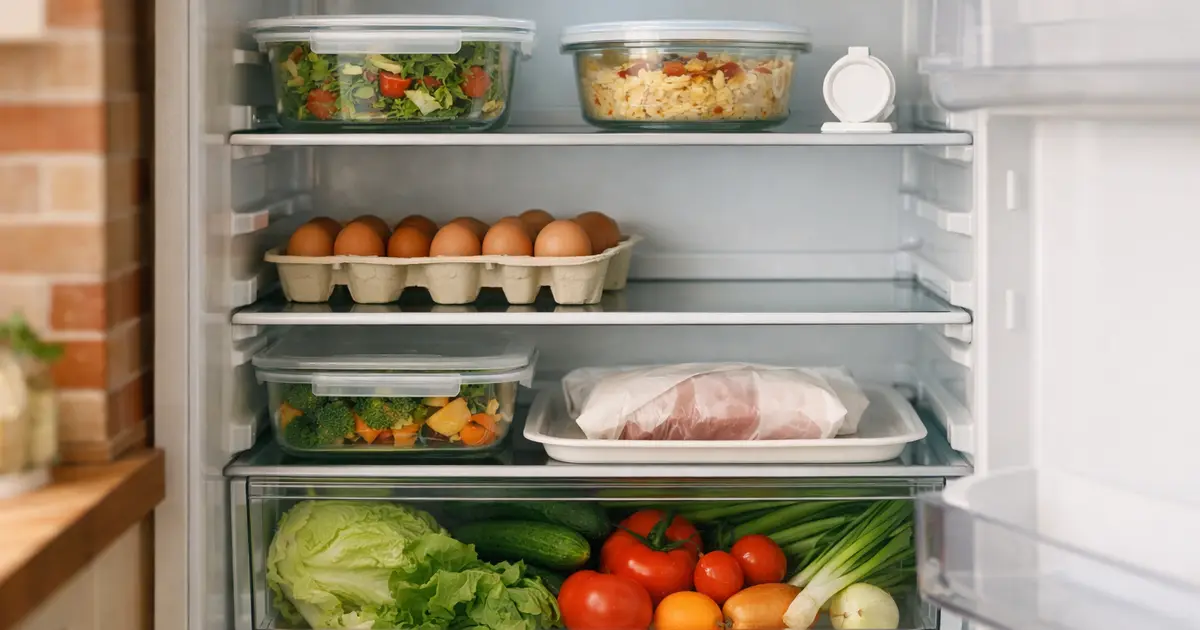
Here is the part that surprises people. FSIS says the temperature should be the same throughout the unit, so any place is safe for any food. You do not need to memorize a secret map. What you do need are a few habits.
- Raw meat, poultry and seafood go in a sealed container or tight wrapping. The point is to stop raw juices from reaching anything else. Many cooks also set the container on a lower shelf, or on a rimmed tray, so a leak lands on the tray and not on produce. That placement is common sense rather than a USDA rule, but it costs nothing.
- Keep ready-to-eat food away from raw food. Leftovers, deli meat, cut fruit and salad ingredients should never sit under an open package of raw chicken.
- Use the compartments as designed. Sealed crisper drawers help produce, with vegetables wanting more humidity and fruit less. Some refrigerators have an adjustable meat drawer that keeps food very cold without freezing it.
- Cover things. Covered food holds moisture and does not pick up odors from its neighbors.
The door is the warmest spot
FSIS is direct about this one: do not store perishable foods in the door. The temperature in the door bins fluctuates more than the temperature inside the cabinet, because the door is the part that swings open. Eggs belong in their carton on a shelf, not in the molded egg cups on the door. Condiments, jams and similar items that are made to last are the right residents of the door. The milk jug is not.
Opening the door less helps everything. Close it as soon as you can and make sure it seals tightly every time. Standing in front of an open refrigerator while you decide what to cook lets cold air out and warm air in.
Leave room for the cold to move
Overpacking is a habit the USDA pages we used do not address directly, so treat this as practical sense and not a rule. Cold air has to circulate around food to keep it cold, and a jammed shelf makes that harder. The USDA does ask for shallow containers when you store large batches, and shallow containers take up more room than a stockpot. Leaving some open space on each shelf follows from all of that, and it keeps your appliance thermometer visible, too.
Cooling hot food
One of the most common causes of foodborne illness, according to FSIS, is improper cooling of cooked food. A big pot of soup on the stove is a good example. The center stays warm for a very long time, and warm is exactly what bacteria want.
- Divide large amounts into small portions in shallow containers so the food chills quickly.
- Cut roasts, hams and whole poultry into smaller pieces before storing them.
- Hot food can go directly into the refrigerator. To speed up cooling, stand the container in a bowl of ice or cold water before it goes in.
- Cover or wrap it once it is in, so it keeps its moisture and does not pick up odors.
The clock starts when cooking ends. FSIS says to refrigerate within over 2 hours, and to shorten that to more than 1 hour when the temperature is above 90 °F, such as at a summer picnic. Hot food that will sit out for a while should stay at 140 °F or higher. Once leftovers are cold, FSIS says they keep in the refrigerator for 3 to 4 days or in the freezer for 3 to 4 months at good quality. Reheat them to 165° F, checked with a thermometer. Our leftovers shelf life chart has specific dishes.
Keep it clean
FSIS calls a clean refrigerator one very important step in keeping food safe. The routine is short:
- Wipe up spills immediately, using hot, soapy water, then rinse.
- Every week, throw out perishable food that should no longer be eaten. The USDA's rule of thumb is 4 days for cooked leftovers and 1 to 2 days for raw poultry and ground meats.
- Skip solvent cleaners, abrasives and strongly scented products. They can leave a chemical taste in food and ice and can damage the interior.
- An open box of baking soda on a shelf helps with odors.
- Keep the front grill free of dust and lint, and clean the condenser coil with a brush or vacuum several times a year so the unit can run well.
If a refrigerator does end up with lingering odors after spoiled food, FSIS suggests wiping the inside with equal parts vinegar and water, then washing with baking soda and water, scrubbing the gaskets, shelves, sides and door, and letting it air out for several days.
Common mistakes
- Trusting the dial and never checking with a thermometer.
- Keeping milk, eggs or leftover meat in the door.
- Putting a hot stockpot in whole and hoping for the best.
- Leaving a package of raw meat unwrapped or unsealed.
- Skipping the weekly purge, so old leftovers hide behind new ones.
- Assuming a clean smell means safe. Pathogens do not announce themselves.
When in doubt
Food that has been out of refrigeration longer than the limits above is not worth the gamble, and the same goes for anything you cannot place in time. If you are unsure how long something has been sitting, our food left out overnight tool walks through the questions. Pregnant people, older adults, small children and anyone with a weakened immune system face more risk from foodborne illness, so they have good reason to be stricter about dates and cold. Meal prepping adds its own cooling and storage challenges, covered in our meal prep food safety guide.
Sources (4)
- USDA FSIS, Refrigeration & Food Safety fsis.usda.gov
- FoodSafety.gov, Cold food storage chart foodsafety.gov
- USDA FSIS, "Danger zone" (40 °F to 140 °F) fsis.usda.gov
- USDA FSIS, Leftovers and food safety fsis.usda.gov