
LookupA searchable reference table
Mold on Food Chart: What the USDA Says to Do
A searchable copy of the USDA table for moldy foods, with each food, the handling advice and the reason. Use it as the full reference behind the guided troubleshooter.
On this page
| Food | What to do | Why |
|---|---|---|
| Luncheon meats, bacon or hot dogs | Discard | Foods with high moisture content can be contaminated below the surface. Moldy foods may also have bacteria growing along with the mold. |
| Hard salami and dry-cured country hams | Use. Scrub mold off the surface. | It is normal for these shelf-stable products to have surface mold. |
| Cooked leftover meat and poultry | Discard | Foods with high moisture content can be contaminated below the surface. Moldy foods may also have bacteria growing along with the mold. |
| Cooked casseroles | Discard | Foods with high moisture content can be contaminated below the surface. Moldy foods may also have bacteria growing along with the mold. |
| Cooked grain and pasta | Discard | Foods with high moisture content can be contaminated below the surface. Moldy foods may also have bacteria growing along with the mold. |
| Hard cheese (not cheese where mold is part of the processing) | Use. Cut off at least 1 inch around and below the mold spot, keeping the knife out of the mold itself so it will not cross-contaminate other parts of the cheese. After trimming, re-cover the cheese in fresh wrap. | Mold generally cannot penetrate deep into the product. |
| Cheese made with mold (such as Roquefort, blue, Gorgonzola, Stilton, Brie, Camembert) | Discard soft cheeses such as Brie and Camembert if they contain molds that are not part of the manufacturing process. If surface mold is on hard cheeses such as Gorgonzola and Stilton, cut off at least 1 inch around and below the mold spot and handle like hard cheese. | Molds that are not a part of the manufacturing process can be dangerous. |
| Soft cheese (such as cottage, cream cheese, Neufchatel, chevre, Bel Paese) and crumbled, shredded and sliced cheeses of all types | Discard | Foods with high moisture content can be contaminated below the surface. Shredded, sliced or crumbled cheese can be contaminated by the cutting instrument. Moldy soft cheese can also have bacteria growing along with the mold. |
| Yogurt and sour cream | Discard | Foods with high moisture content can be contaminated below the surface. Moldy foods may also have bacteria growing along with the mold. |
| Jams and jellies | Discard | The mold could be producing a mycotoxin. Microbiologists recommend against scooping out the mold and using the remaining condiment. |
| Firm fruits and vegetables (such as cabbage, bell peppers, carrots) | Use. Cut off at least 1 inch around and below the mold spot, keeping the knife out of the mold itself so it will not cross-contaminate other parts of the produce. | Small mold spots can be cut off firm fruits and vegetables with low moisture content. It is difficult for mold to penetrate dense foods. |
| Soft fruits and vegetables (such as cucumbers, peaches, tomatoes) | Discard | Soft fruits and vegetables with high moisture content can be contaminated below the surface. |
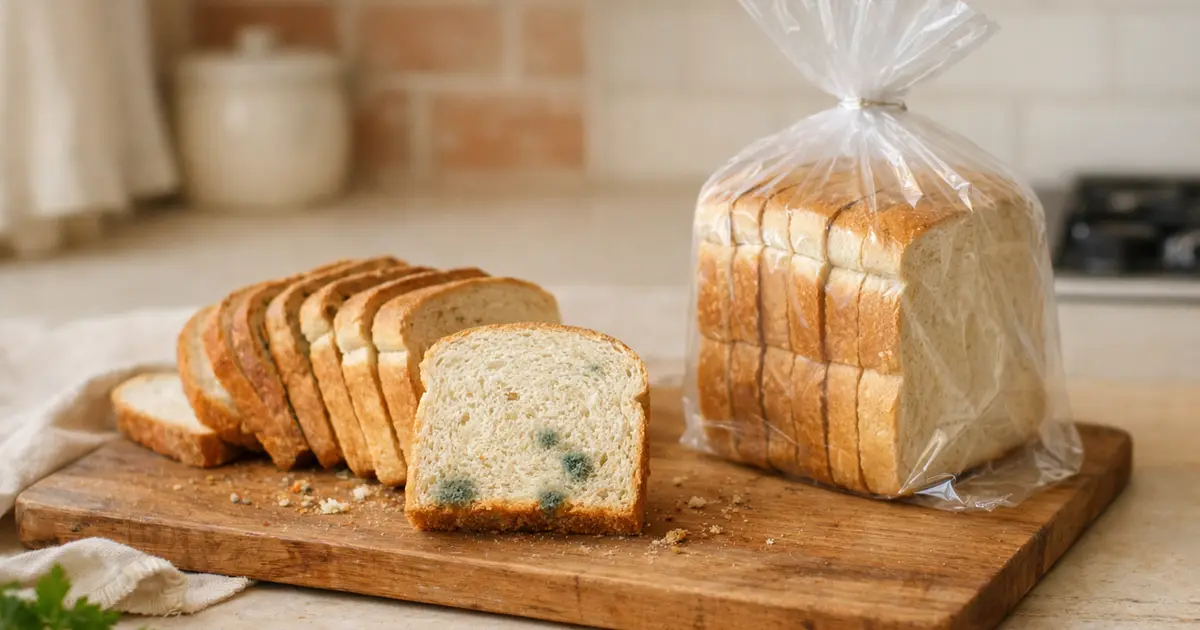
| Bread and baked goods | Discard | Porous foods can be contaminated below the surface. |
| Peanut butter, legumes and nuts | Discard | Foods processed without preservatives are at high risk for mold. |
What this table is
This page reproduces the table the USDA Food Safety and Inspection Service publishes about mold, one row per food, with these columns: the food, what to do and why. We copied the wording from the saved page and checked that each number in it matches. If you only want a quick ruling on one food, the moldy food troubleshooter asks questions and gives a single answer. This page is the whole reference, including the reasons behind each ruling.
How to read it
The "What to do" column is short on purpose. Most rows say discard. The few that say use come with a condition, and the condition matters as much as the verdict: a wide cut, a clean knife and fresh wrap for hard cheese, and a scrub for dry-cured ham. Look for the family a food belongs to: high moisture, porous, dense or made without preservatives. The reason column explains why the row got its verdict.
Mold, mycotoxins and aflatoxin
Molds are microscopic fungi. Some cause allergic reactions and breathing problems, and a few, in the right conditions, produce mycotoxins, poisonous substances that can make people sick. Mycotoxins turn up mainly in grain and nut crops, but are also known on celery, grape juice, apples and other produce. The best known are the aflatoxins, which are cancer-causing poisons found especially in field corn and peanuts. Government agencies monitor peanuts and field corn for them.
Mushroom poisoning is a different matter. It comes from toxins that mushrooms make naturally, and most cannot be made safe by cooking, canning or freezing.
Why the surface tells you so little
What you see is the fuzz at the top of a much larger structure. The roots may run deep and be hard to see, and moldy foods can also have invisible bacteria growing alongside. That is the logic behind the table: dense foods are cut with a generous margin, while soft, wet or porous foods are discarded because the contamination may be anywhere.
Cold does not stop it
Most molds prefer warmth, but they can grow at refrigerator temperatures, and they tolerate salt and sugar better than most other food invaders. That is why jam and cured meats can grow mold in the refrigerator. Keep the refrigerator at 40 °F or below, and remember that food held at 0 °F is safe, though thawed items can grow mold again.
Worked example: one shelf, several finds
On a Saturday clean-out you find mold on a jar of strawberry jam, on a wedge of Parmesan and on a tomato. Search the table for jam: discard, because the mold could be producing a mycotoxin and scooping it out is not recommended. Search Parmesan: use it after cutting at least 1 inch around and below the spot. Search tomato: discard, since soft produce is moist inside. Then clean the shelf, because spores build up.
When in doubt
If a food is not in the table, use the closest family or simply throw it away. Those who are pregnant, elderly, small children or immunocompromised should follow their doctor's guidance. See also food left out overnight and how long food lasts.
Sources
- USDA FSIS, Molds on food: are they dangerous? fsis.usda.gov
- USDA FSIS, "Danger zone" (40 °F to 140 °F) fsis.usda.gov
- USDA FSIS, Freezing and food safety fsis.usda.gov