
GuideA plain-language guide with a worked example
Air fryer and multi-cooker food safety
Air fryers and multi-cookers do not change the safe temperatures. A thermometer, not a timer from a recipe site, tells you when meat and poultry are done.
On this page
Air fryers and electric multi-cookers promise dinner in a hurry, and recipe sites are full of cook times for them. The trouble is that those times came from somebody else's machine, somebody else's chicken and somebody else's freezer. This guide explains what changes between appliances, what never does, and how to check the middle of a piece of food instead of guessing.
How these appliances cook
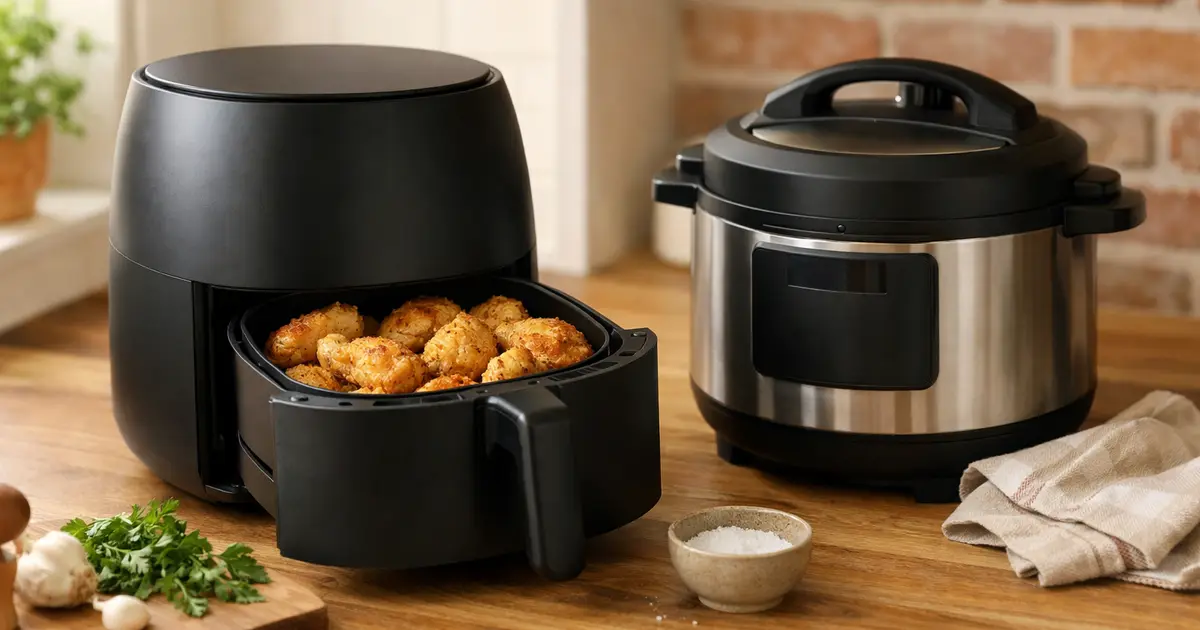
An air fryer is, as FSIS puts it, essentially a countertop convection oven. A heating element sits above the food and a fan pushes very hot air around it, so the outside turns crisp while the inside stays moist. The appliance is airtight, which concentrates the heat. FSIS says foods generally need 5 to 25 minutes at a range of 350 degrees F to 400 degrees F, and that you should follow the instructions on a food package when there is one.
An electric multi-cooker is a different animal. It cooks under pressure, and Nebraska Extension points out that the time needed depends on the size and model of the cooker, the size and cut of the meat, the amount of liquid and the way you release the pressure. A time printed in a recipe is therefore a starting guess.
Do not crowd the basket
Air fryers have little room inside. FSIS warns that overcrowding blocks the air circulation that cooks the food, and that overfilling the basket can leave food unevenly cooked or undercooked. Nebraska Extension adds that overfilling interferes with browning. For a large amount, cook in batches. The result is crispier food and a more reliable thermometer reading.
Frozen and breaded foods
Package directions exist because the maker tested that product. FSIS tells you to follow them for both raw and pre-cooked foods. The one hard rule on its page is that raw, stuffed breaded chicken breast products should not be cooked in an air fryer at all. A golden crust proves nothing about the middle, so the crumbs are the reason to probe, not a reason to skip it.
Checking doneness
FSIS says always to check that food has reached a safe minimum internal temperature with a food thermometer. Nebraska Extension calls this the only way to ensure safety for meat, poultry and egg products. Place the probe in the thickest part, away from bone, fat and gristle. For thin items, slide it in from the side to the center. Most thermometers read within 2 to 4 degrees F, and only if placed correctly.
The temperatures to aim for in an air fryer:
- Whole cuts of beef, pork, veal and lamb: 145 degrees F, followed by a short rest.
- Ground meats: 160 degrees F.
- Poultry: 165 degrees F.
- Casseroles: 165°F. Eggs: 160°F.
The full list for every food is in our safe internal temperature chart.
When a multi-cooker comes up short
Nebraska Extension notes that the most important step is often left out of pressure-cooking recipes: checking with a thermometer. If the food has not reached its temperature after pressure cooking, keep going. You can pressure cook again, use the sauté function, or finish on the stovetop or in the oven. Do not serve it and hope.
After the cooking
Food sitting in the basket or the pot is still food on the counter. FSIS says to refrigerate leftovers within 2 hours, or they can enter the danger zone. Keep raw and cooked foods apart too: no cooked food on the plate that held the raw meat, and separate cutting boards for raw meat and for produce. Our leftovers chart says how long each dish keeps.
Worked example
You pull a bag of breaded chicken tenders from the freezer. The box suggests a time and temperature, so you use those, but your basket is stacked high with tenders for the whole family. You cook half, in a single layer, then the other half, because stacked pieces would block the hot air.
When the timer rings the tenders look wonderful. You do not trust the crust. You take the biggest tender, push the probe in from the side so the tip reaches its center, and read the display. Anything under 165 degrees F goes back for another few minutes, and you test again, each time in a fresh spot on a different piece, since pieces finish at different times.
Later, the leftover tenders go into a shallow container and the refrigerator, well inside 2 hours. The next evening you reheat them in the air fryer and probe once more.
Frequently asked questions
Is a recipe's cook time enough if the food looks done? No. Color and crispness are not safety signals. The time is only a starting point, because appliances vary in size and power.
Can I bake in an air fryer? Nebraska Extension says you can, with the right extras: glass baking dishes and muffin tins that fit the basket work, and cookies can go on parchment paper.
Do multi-cookers and air fryers use different safe temperatures? No. The same minimums apply to every method, and the Nebraska chart matches the USDA list.
What if my thermometer reads low in one spot? Keep cooking and check again. Test several pieces when you cook a batch.