
LookupA searchable reference table
Safe Internal Temperature Chart for Meat, Poultry, Eggs and Fish
Federal charts side by side, in their own words. Cook to at least these minimums, measured with a food thermometer; going higher is a taste choice.
On this page
| Food | Minimum internal temperature | Rest time | Whose chart |
|---|---|---|---|
| Beef, pork, veal and lamb steaks, chops and roasts | 145 degrees F (62.8 degrees C) | At least 3 minutes | FSIS |
| Beef, bison, veal, goat and lamb: steaks, roasts, chops | 145°F (63°C) | 3 minutes | FoodSafety.gov |
| Pork: steaks, roasts, chops | 145°F (63°C) | 3 minutes | FoodSafety.gov |
| Ground meats | 160 degrees F (71.1 degrees C) | None listed | FSIS |
| Ground meat and sausage (beef, pork) | 160°F (71°C) | None listed | FoodSafety.gov |
| Rabbit and venison, wild or farm-raised | 160°F (71°C) | None listed | FoodSafety.gov |
| Ground poultry | 165 degrees F | None listed | FSIS |
| All poultry: breasts, whole bird, legs, thighs, wings, ground poultry, giblets and stuffing | 165 degrees F (73.9 degrees C) | None listed | FSIS |
| Chicken, turkey and other poultry: whole bird, breasts, legs, thighs, wings, ground poultry, giblets, sausage, stuffing inside poultry | 165°F (74°C) | None listed | FoodSafety.gov |
| Chicken breasts, drumsticks, thighs and wings | 165°F | None listed | FSIS chicken page |
| Whole chicken | 165°F | None listed | FSIS chicken page |
| Chicken breasts, thighs and wings: where to measure | Thickest area, avoiding the bone | None listed | FSIS thermometer page |
| Chicken that is still pink | Safe once every part reaches 165 °F | None listed | FSIS color page |
| Ham, fresh or smoked (uncooked) | 145 degrees F (62.8 degrees C) | At least 3 minutes | FSIS |
| Raw ham | 145°F (63°C) | 3 minutes | FoodSafety.gov |
| Fully cooked ham, to reheat | 140 degrees F (60 degrees C) if packaged in a USDA-inspected plant; 165 degrees F (73.9 degrees C) for all others | None listed | FSIS |
| Precooked ham, to reheat | 165°F (74°C); cooked hams packaged in USDA-inspected plants: 140°F (60°C) | None listed | FoodSafety.gov |
| Eggs | 160 degrees F (71.1 degrees C) | None listed | FSIS |
| Raw eggs | Cook until yolk and white are firm | None listed | FoodSafety.gov |
| Egg dishes such as frittata and quiche | 160°F (71°C) | None listed | FoodSafety.gov |
| Fish and shellfish | 145 degrees F (62.8 degrees C) | None listed | FSIS |
| Fish, whole or filet (salmon, tuna, tilapia, pollock, bass, cod, catfish, trout and others) | 145°F (63°C), or cook until flesh is no longer translucent and separates easily with a fork | None listed | FoodSafety.gov |
| Shrimp, lobster, crab and scallops | Cook until flesh is pearly or white, and opaque | None listed | FoodSafety.gov |
| Clams, oysters, mussels | Cook until shells open during cooking | None listed | FoodSafety.gov |
| Leftovers | 165 degrees F (73.9 degrees C) | None listed | FSIS |
| Leftovers, any type | 165°F (74°C) | None listed | FoodSafety.gov |
| Casseroles | 165 degrees F (73.9 degrees C) | None listed | FSIS |
| Casseroles, meat and meatless | 165°F (74°C) | None listed | FoodSafety.gov |
What the chart contains
This table puts a pair of federal charts side by side: the Safe Minimum Internal Temperature Chart from the USDA's FSIS, and the safe minimum internal temperatures chart on FoodSafety.gov, which was last reviewed on November 21, 2024. We kept each chart's own words, including its mix of "degrees F" and "°F" and its rest times. The last column tells you which chart a row comes from. When both charts list a food, you see both rows, and the temperatures agree.
FoodSafety.gov adds foods that the FSIS chart lacks, such as bison, goat, rabbit, venison and egg dishes, and it spells out seafood doneness cues for shrimp, clams and similar shellfish.
Reading the numbers
Check with a food thermometer before removing food from the heat. Steaks, chops and roasts of beef, pork, veal and lamb need 145 degrees F and a rest of at least 3 minutes. Ground meats need 160 degrees F. All poultry and ground poultry need 165 degrees F, and so do leftovers and casseroles. Eggs need 160 degrees F. A cooked ham packaged in a USDA-inspected plant can be reheated to 140 degrees F, while other cooked hams go to the poultry temperature.
Rest time is part of the instruction, not an extra. The rest lets heat finish moving through the meat, and FoodSafety.gov says it allows the innermost parts and juices of the meat to become fully and safely cooked.
Internal temperature for chicken
Every cut of chicken has the same target: 165°F at the coolest point. That covers breasts, drumsticks, thighs and wings, and the chart extends the same figure to a whole bird, ground chicken, giblets and stuffing. So the answer to "chicken breast internal temp" and "chicken thigh temperature" is identical, even though the cuts feel nothing alike on the plate. Dark meat tastes better when cooked well past the minimum, and many cooks pull thighs later for that reason. That is a texture choice, because the safety line is already crossed.
Where you push the probe matters as much as the number. For breasts, thighs and wings, aim for the thickest area and stay clear of the bone, which heats faster than the meat and gives a false high reading. For a thin cutlet, slide the probe in from the side until its tip sits in the center. A whole bird is checked in three places: the deepest part of the thigh, the deepest part of the wing and the meatiest part of the breast.
Color will not help you here. FSIS says appearance and color are not reliable indicators of safety, and that a thermometer is the only way to know harmful bacteria were destroyed. Cooked chicken can look white, pink or tan and still be fine: once every part reaches 165 °F, meat that stays pink is safe to eat. The pink comes from hemoglobin in the tissue reacting with oven gases, and it shows up most in younger birds. Chicken from a grill or smoker can keep a pink rim about one-half inch wide even when it is well past the minimum.
One difference from beef and pork is worth noticing. The FSIS chart attaches a rest time to steaks, chops and roasts, but it lists none for poultry. Resting chicken for juiciness is fine, yet nothing in the chart makes it a safety step.
Doneness is your call, safety is not
The charts list minimums. FSIS notes that for personal preference you may cook to higher temperatures, and plenty of people do, for tender pot roast or well-done steak. Going lower than the chart for the sake of taste is not a preference, it is a risk. Let the thermometer, not the color, decide when the minimum is met.
Worked example: Sunday dinner
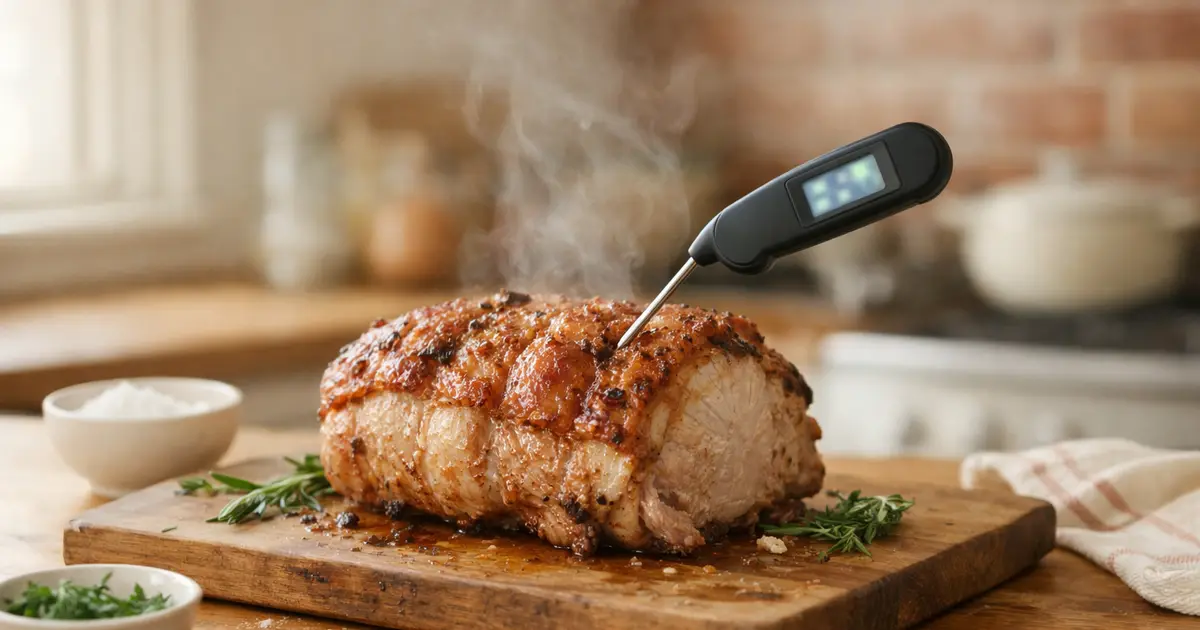
You roast a pork loin, grill burgers and reheat last night's casserole. The loin is a roast, so you remove it from the oven at the roast temperature in the table and let it rest before slicing. The burgers are ground meat and need the higher ground-meat figure. Beef steak and ground beef cooked together do not share a target. The casserole needs the leftovers temperature all the way through. Check the middle of the dish, not just the edge.
Common questions
What is the internal cooking temp for chicken?
Chicken is done, from a safety standpoint, when the thermometer reads the poultry figure shown in the table at the coolest spot. That single number applies whether you roast a whole bird, bake parts or cook ground chicken.
What is the chicken breast internal temp?
The same as every other chicken cut. Put the probe in the thickest part of the breast, away from bone, and for a thin breast insert it through the side so the tip reaches the center.
What temperature should a chicken thigh reach?
The chart gives thighs the same minimum as breasts. Thighs hold more connective tissue, so many cooks let them climb higher for a softer bite, which FSIS accepts as personal preference.
Is pink chicken safe to eat?
Yes, if a food thermometer shows every part has reached the minimum. Color alone cannot tell you, in either direction: well-cooked chicken can stay pink, and chicken can look done before the center is hot enough.
Does chicken need to rest before eating?
The chart lists no rest time for poultry. Only the steaks, chops and roasts of red meat in the table above carry a rest time.
Related pages
Cooked food cools to safe storage under the rules on the leftovers shelf life chart. For eggs and egg dishes in depth, see the egg storage and safety guide. Oven times by cut are on the chicken and turkey cooking times page.
When to ask
If your thermometer is untested or the food was handled unsafely before cooking, cooking to temperature may not repair it. Discard anything you doubt. Pregnant people, older adults, young children and those with weakened immune systems should follow their doctor's guidance on rare or undercooked foods.
Sources
- USDA FSIS, Safe minimum internal temperature chart fsis.usda.gov
- FoodSafety.gov, Safe minimum internal temperatures foodsafety.gov
- USDA FSIS, "Danger zone" (40 °F to 140 °F) fsis.usda.gov
- USDA FSIS, Freezing and food safety fsis.usda.gov
- USDA FSIS, Chicken from Farm to Table fsis.usda.gov
- USDA FSIS, Food Thermometers fsis.usda.gov
- USDA FSIS, The Color of Meat and Poultry fsis.usda.gov
- USDA FSIS, Doneness Versus Safety fsis.usda.gov