
ChecklistTick as you go, saved in this browser, prints cleanly
Thanksgiving Turkey Thawing and Food Safety Timeline
A turkey timeline from thaw day to leftovers, using USDA's exact refrigerator, cold-water and microwave thawing rules and poultry temperature.
On this page
Thanksgiving turkey thawing and food safety timeline
Work back from the meal. This list covers thawing, safe cooking temperatures and leftovers. It does not give a roasting-time table: follow the directions on your turkey's label for time.
0 of 24 done
Days ahead: start the thaw
Thawing is the step that cannot be rushed safely.
FSIS notes that a colder refrigerator and cooler spots in it can slow the thaw.
Behind schedule: faster safe options
A leaking bag can let in bacteria, and the meat can absorb water.
Day before
Cooking day
After the meal
Sources (6)
- USDA FSIS, The big thaw: safe defrosting methods fsis.usda.gov
- USDA FSIS, Safe minimum internal temperature chart fsis.usda.gov
- USDA FSIS, Leftovers and food safety fsis.usda.gov
- USDA FSIS, "Danger zone" (40 °F to 140 °F) fsis.usda.gov
- USDA FSIS, Freezing and food safety fsis.usda.gov
- USDA FSIS, FoodKeeper data (version 128) fsis.usda.gov
What this timeline gives you
A frozen turkey is the one holiday item you cannot rush. This checklist works backward from the meal: when to start thawing, what to do if you are behind, what to check on cooking day and how to put leftovers away before they become a risk. Every step carries the USDA source behind it.
It deliberately has no roasting-time table. The roasting time depends on the weight and style of your bird, and we do not yet have a source detailed enough to publish one. The chicken and turkey times page lists poultry parts and says the whole-turkey chart is coming. Until then, use the directions printed on your turkey's label and rely on the thermometer.
The thawing rule, in USDA's words
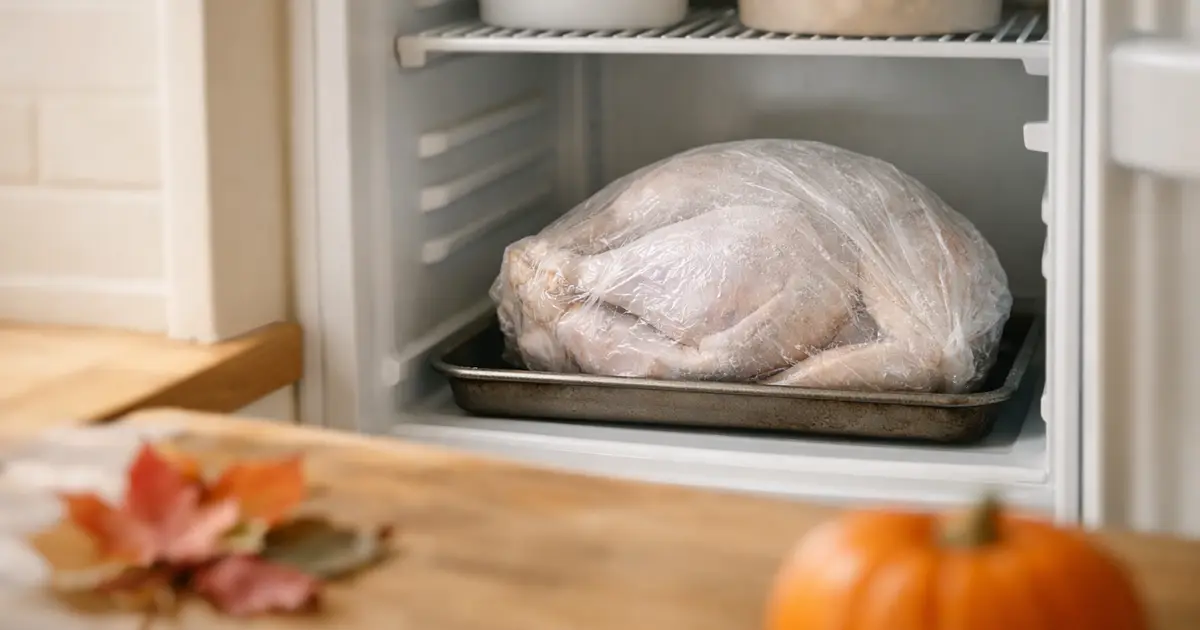
FSIS says a large frozen item like a turkey requires at least a day (24 hours) for every 5 pounds of weight. Find the weight on the package and mark the day it must go into the refrigerator on your calendar. We do not do that arithmetic for you, because your bird, your refrigerator and your schedule are yours.
If you fall behind, USDA lists other safe methods. In cold water, the turkey stays in a leak-proof package, fully submerged, with the water changed every 30 minutes, and USDA estimates about 30 minutes per pound for whole turkeys. In the microwave, plan to cook it right after. Either way, a turkey thawed by those methods is cooked immediately. It is also safe to cook from frozen; USDA says it takes approximately 50% longer than the recommended time for a fully thawed bird.
What is never safe: thawing on the counter, in hot water, in a garage, basement, car or dishwasher, or outdoors.
Cooking day and leftovers
Use an oven temperature no lower than 325 °F, remove the giblet pack as soon as you can loosen it, and check each of the thigh, wing and breast with the thermometer. Stuffing must also reach 165 degrees F. Keep hot dishes at 140 °F or warmer, and do not leave food out longer than 2 hours.
After dinner, refrigerate leftovers within 2 hours. Cut the turkey into smaller pieces, slice the breast and put gravy and sides in shallow containers. Eat leftovers within 3 to 4 days or freeze them, and reheat to 165 °F.
Worked example: Thanksgiving falls on Thursday
You bought a frozen turkey the week before and read the weight on the label. Using USDA's rule, you work back from Thursday and write the refrigerator day on the calendar. If that day passes with the bird still frozen, you switch to cold water on Wednesday, keep the bag submerged and change the water on schedule. On Thursday you check the thigh, wing and breast with a thermometer. At dinner's end you carve, pack the leftovers into shallow containers and have them chilled before the refrigeration limit, and label the date.
Special care
If a guest is pregnant, elderly, a baby or immunocompromised, let their doctor's advice guide the leftovers and reheated stuffing. If the turkey sat out beyond the limit, discard it rather than gamble.
Related pages
See the freezer meal planner for freezing leftovers, the weekly meal planner for the week after, and how long does food last.