
GuideA plain-language guide with a worked example
How long does meal prep last? A food-safe plan for the week
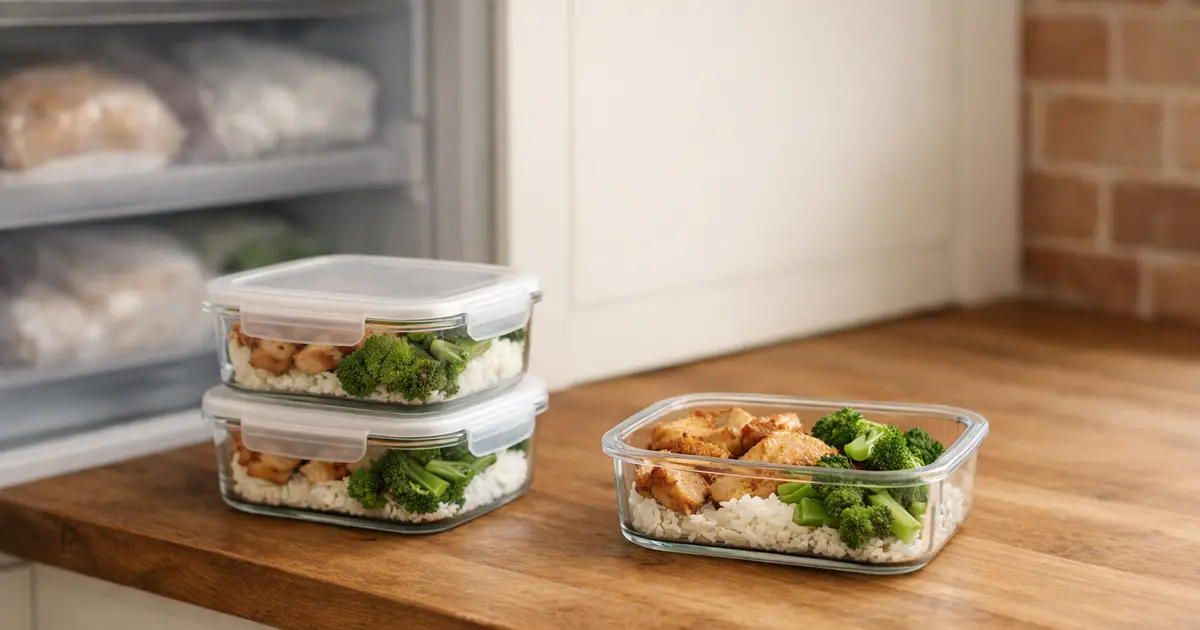
Cooked meal prep keeps only a few days in the refrigerator, so a full week of lunches needs the freezer. Cool batches fast in shallow containers and reheat until steaming hot.
On this page
Sunday meal prep is one of the best habits a busy household can build. You shop once, cook once and spend the week grabbing a ready lunch instead of buying one. The catch is that a full week is longer than cooked food is meant to sit in a refrigerator. This guide sets out how long prepped food keeps according to the USDA, how to split a batch between the fridge and the freezer, and how to cool, pack and reheat it so the Friday lunch is as safe as the Monday one.
Why a week of prepped lunches needs the freezer
USDA's Food Safety and Inspection Service (FSIS) treats meal prep the same way it treats any leftovers. Once food is cooked, it starts a short refrigerator clock of 3 to 4 days. FSIS explains that refrigeration slows bacterial growth rather than stopping it, and that the bacteria which cause illness are a different family from the spoilage bacteria that make food smell and taste off. So a container that seems fine on the sixth day can still be a risk, and the sniff test cannot settle it.
The practical result is a split. Pack the first few days' meals for the refrigerator and put the rest straight into the freezer. Food held at 0 °F stays safe for as long as it stays frozen, and FSIS gives freezer times only as a guide to best quality. For prepped leftovers that quality window is 3 to 4 months, which is far more than a busy week needs.
How long common prep foods keep
The FoodSafety.gov cold storage chart lists the refrigerator limits that matter most for a prep day. These are safety limits for food kept at 40 °F or below.
| What you prepped | Refrigerator | Freezer, for quality |
|---|---|---|
| Cooked meat or poultry | 3 to 4 days | 2 to 6 months |
| Soups and stews with meat or vegetables | 3 to 4 days | 2 to 3 months |
| Chicken, tuna, egg or macaroni salad | 3 to 4 days | Does not freeze well |
| Hard-cooked eggs | 1 week | Do not freeze |
| Raw chicken or turkey pieces, waiting to be cooked | 1 to 2 days | Freeze if you will not cook it in time |
| Raw ground meat, waiting to be cooked | 1 to 2 days | 3 to 4 months |
Notice how short the raw rows are. If your plan is to cook chicken on Wednesday from a pack bought on Saturday, freeze the pack on the day you buy it and thaw it in the fridge beforehand. Our leftovers shelf life chart covers more cooked dishes, and the food storage lookup has raw ingredients.
Cook it to a safe temperature first
Safe leftovers start with safe cooking. FSIS asks you to check with a food thermometer rather than by color: whole cuts of beef, pork, lamb and veal reach 145° F with a rest before slicing, ground meats reach 160° F, and all poultry reaches 165° F. Big batches cook unevenly, so check the thickest pieces and the middle of the pan, not just the edges. The safe internal temperature chart lists every food.
Cool big batches quickly
Cooling is where most meal prep goes wrong. A full stockpot of chili or a deep tray of rice holds its heat for a long time, and the food spends hours between 40 °F and 140 °F, the range where bacteria multiply fastest. FSIS gives a simple fix: divide large amounts into shallow containers so they chill quickly, and cut roasts or whole birds into smaller pieces. It is fine to refrigerate food while it is still hot, or chill the containers quickly by standing them in a sink of ice water.
A good rhythm is to portion while the food is still warm, leave the lids slightly open until the steam stops, then close them and refrigerate. Space the containers apart on the shelf instead of stacking them into a tower, so cold air can reach every side.
Pack for the fridge and the freezer
Airtight containers keep bacteria out, hold in moisture and stop the rice from tasting like last night's onions. For the freezer, the FSIS freezing guidance adds a few points that make a real difference to quality:
- Freeze food as fast as you can. FSIS says that, ideally, a food 2-inches thick should freeze completely in about 2 hours. Spread new containers out in a single layer and stack them only once they are frozen solid.
- Wrap well to prevent freezer burn. Freezer burn is not a safety problem, only dry, leathery spots, but it ruins texture.
- Label each container with what it is and the date it was made, so the oldest gets eaten first.
- Skip the freezer for foods that do not hold up. FSIS names mayonnaise, cream sauce and lettuce as poor freezers, so keep dressings and crisp greens separate and add them on the day.
Thaw and reheat the right way
Move tomorrow's frozen lunch to the refrigerator the night before. FSIS notes that most foods need a day or two to thaw that way, but a single portion usually softens overnight. Food thawed in the fridge can be eaten within 3 to 4 days or refrozen. If you forget, reheating straight from frozen is safe; it just takes longer. Cold water and the microwave are also safe ways to thaw, as long as you cook the food right after. Our guide to thawing food safely covers each method.
When you reheat, bring the food to 165 °F on a thermometer, and bring soups, sauces and gravies to a rolling boil. Cover the dish and stir or rotate it partway through so there are no cold pockets in the middle.
Carrying prepped meals to work
A prepped lunch is perishable once it leaves home. FSIS limits perishable food to 2 hours at room temperature, or 1 hour when the air is above 90 °F. Carry it in an insulated bag with something frozen beside it, and put it in a refrigerator at work if there is one.
A food-safe prep plan for the week
- Prep day: cook to temperature, portion into shallow containers, refrigerate within 2 hours, and freeze everything planned for the back half of the week.
- Each evening: move the next day's frozen portion to the fridge to thaw.
- Each meal: reheat to 165 °F, and do not leave the box out on a desk all afternoon.
- End of the window: anything still in the refrigerator after 3 to 4 days gets thrown out, not tasted.
If you want a full planning sheet, the weekly meal planner and freezer meal planner walk through the same steps as checklists. If you are cooking for someone pregnant, an older relative, a small child or anyone whose immune system is weakened, hold to these limits strictly.
Sources (5)
- USDA FSIS, Leftovers and food safety fsis.usda.gov
- USDA FSIS, Freezing and food safety fsis.usda.gov
- USDA FSIS, Refrigeration & Food Safety fsis.usda.gov
- FoodSafety.gov, Cold food storage chart foodsafety.gov
- USDA FSIS, "Danger zone" (40 °F to 140 °F) fsis.usda.gov