
GuideA plain-language guide with a worked example
Cooking for a crowd: food safety for potlucks, parties and volunteer meals
Large gatherings go wrong when food sits too long between hot and cold. Cook to temperature, cool big batches in shallow containers, hold food hot or cold, and clear the table on a timer.
On this page
A potluck table, a church supper or a family reunion feeds a lot of people from a lot of kitchens, and no one person sees the whole journey of every dish. That is what makes crowd cooking different from Tuesday dinner. Food is made earlier, carried farther, served slowly and picked at for hours. The USDA wrote a booklet for exactly this situation, aimed at volunteers who prepare food at home and bring it along or cook and serve at the event itself. This guide turns its advice, together with the agency's pages on the danger zone and on leftovers, into a plan you can follow.
Why a crowd raises the stakes
Bacteria grow most rapidly between 40 °F and 140 °F, and in that range their numbers can climb fast, doubling in as little as 20 minutes. A buffet is, in effect, a long stretch of time spent in that range unless you work to prevent it. A casserole that is fine at the start of a party can be a problem by the end, and the guest who takes the last scoop gets the most risk.
The USDA also points out that its brochure is a guide for consumers, not a replacement for local rules. If your event is large, public or run by an organization, check with your local or state health department about any regulations for food preparation and service.
Plan before you cook
Decide what each dish needs at the table. Hot dishes need a heat source that holds temperature, and cold dishes need ice or refrigerator space. If you cannot picture how a dish will stay hot or cold for the length of the event, change the menu or the serving plan now. A big pot of chili in a slow cooker is easier to manage than a pan of fried chicken with no warming tray. Our slow cooker guide covers the safe way to use one for holding.
Gather the equipment ahead of time: a food thermometer, shallow pans, plenty of clean utensils, ice, chafing dishes or warming trays, and a clean cloth for wiping surfaces. Wash hands with warm water and soap for at least 20 seconds before you start and after handling raw meat.
Cook it through
For crowd cooking, the thermometer matters even more than at home, because you may be handling several large pieces at once. The USDA's cooking temperatures are:
- Beef, pork, lamb or veal steaks, chops and roasts: 145° F.
- Ground beef, pork, lamb and veal: 160° F.
- All poultry: 165° F.
When roasting meat and poultry in the oven, keep the setting at 325 °F or higher. A very low oven can leave food lingering in the danger zone. Our thermometer guide explains where to place the probe in large cuts.
Cooking ahead
Making food a day early is a good way to stay calm, but it adds a cooling step and a reheating step. Cook the dish to temperature, cool it quickly (see the next section), keep it refrigerated, and bring it back to 165 °F before it goes on the table. Reheat sauces, soups and gravies until they reach a rolling boil.
Layered dishes and casseroles deserve extra care when they are assembled ahead, because the center is the last part to warm through. Reheat the finished dish all the way to 165 °F, and check the middle with a thermometer rather than the edges.
Cooling large batches
Improper cooling is one of the most common causes of foodborne illness, according to the USDA. A deep pot of soup holds its heat in the middle for a long time, and that is the problem. To cool food quickly:
- Divide large amounts into shallow containers so heat can escape.
- Cut roasts and hams into smaller pieces. Slice turkey breast, and leave legs and wings whole if you like.
- Hot food can go straight into the refrigerator, or sit in an ice or cold water bath first.
- Cover or wrap the containers so leftovers stay protected while they chill.
The goal is to have food at 40 °F or below within two hours of cooking. When you bring food out of a warming appliance, the same clock applies.
Transporting food
Transport is where good plans fall apart, because the car is a place with no thermometer and no clock. Hot dishes should arrive at 140 °F or warmer, which means well-wrapped, insulated carriers and a short trip. Cold dishes belong in coolers packed with ice, not on the back seat. Keep raw foods away from ready-to-eat dishes. The out-of-refrigeration clock starts when food leaves the cold, not when it reaches the table, so count the drive.
Holding and serving
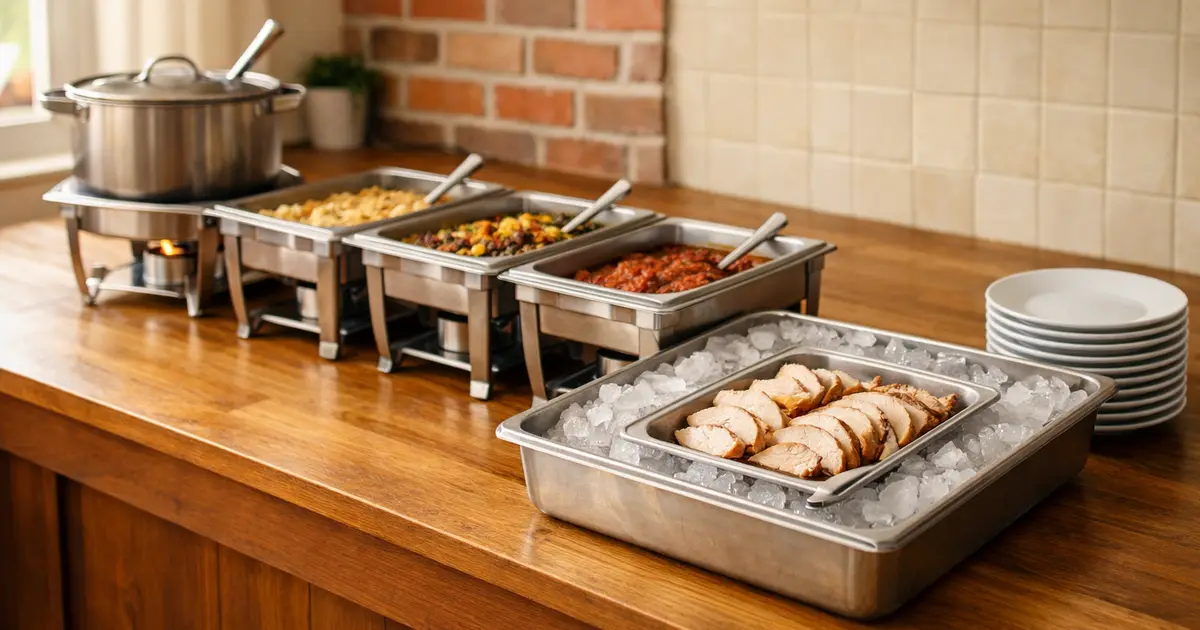
At the buffet, hot food stays hot in chafing dishes, preheated steam tables, warming trays or slow cookers. Cold food stays cold in containers on ice. The USDA suggests nesting dishes in bowls of ice, or using small serving trays and replacing them often with fresh ones from the refrigerator. Replacing is better than topping off, because new food added to an old, warm dish just inherits its history.
Use a clean spoon for every dish, and keep a few spares nearby. Put the thermometer in the food now and then to confirm the temperatures; it is a quick check that tells you more than a glance does.
Leftovers
Throw away perishable food that has been out longer than 2 hours, or 1 hour when it is above 90 °F, such as at a summer picnic. Do not be tempted to send it home with guests for tomorrow. What remains in good shape should be refrigerated within two hours of cooking, in shallow, covered containers.
Leftovers keep for 3 to 4 days in the refrigerator or 3 to 4 months in the freezer. Our leftovers chart lists common dishes. If you are packing meals for a freezer, the companion meal prep guide goes deeper.
A quick checklist
- Check local rules if the event is public or organized.
- Thermometer, shallow pans, ice and warming equipment ready.
- Everything cooked to temperature and verified with a probe.
- Cooked-ahead dishes cooled fast, kept cold and reheated until steaming.
- Hot food held hot, cold food held cold, and a timer started when food goes out.
- Trays replaced rather than topped off.
- Leftovers cooled in shallow containers and refrigerated promptly.
When in doubt
If you cannot say how long a dish has been sitting out, treat it as too long. The USDA's rule is simple and a little harsh: perishable food left out past the time limit gets discarded. Losing a tray of potato salad is cheaper than an afternoon of illness for your guests. Do not be shy about asking the cook how a dish was kept, and do not be shy about answering the same question yourself.
Sources (3)
- USDA FSIS, Cooking for Groups: A Volunteer's Guide to Food Safety fsis.usda.gov
- USDA FSIS, "Danger zone" (40 °F to 140 °F) fsis.usda.gov
- USDA FSIS, Leftovers and food safety fsis.usda.gov