
GuideA plain-language guide with a worked example
How to use a food thermometer
A food thermometer is the only dependable way to know meat, poultry and egg dishes are cooked through. Put the tip in the right spot, check it against ice water, and ignore color.
On this page
A cook can see browning, feel firmness and watch juices run, and none of it reliably says whether the middle of a dish has been hot enough to be safe. A thermometer replaces that guesswork with a number. This guide covers the types you can buy, exactly where the probe belongs in different foods, how to confirm the device is telling the truth, and why the look of the food misleads.
Why a number beats a look
The USDA separates a pair of ideas that cooks often merge. "Doneness" is about taste: texture, appearance and juiciness. "Safe" means the food has been heated long enough, and hot enough, to kill the bacteria that cause illness. Most of those germs are destroyed between 140 degrees F and 165 degrees F, which is why the chart has different lines for different foods. Only a probe tells you which side of that line the center of a dish is on. FSIS notes that just about 15% consistently use one, and that one in four hamburgers that look finished may not be safely cooked.
A good thermometer also protects the quality of dinner. When you know the chicken breast has arrived, you can pull it off the heat instead of cooking on "just to be sure", which is how dry meat happens.
Choosing a thermometer
FSIS groups kitchen thermometers into digital and dial styles.
- Thermocouple. The fastest digital kind, with readings in about 2-5 seconds. It suits thin and thick foods alike and can be calibrated, but it costs more and is harder to find in ordinary shops.
- Thermistor. Also quick and also good for thin foods. Some models can be calibrated.
- Oven cord and wireless probes. These are built to stay in the food while it cooks, so you can watch a roast without opening the oven door.
- Thermometer forks. Convenient at the grill, but they cannot be calibrated and are not meant to stay in the food.
- Dial, instant-read. Inexpensive and easy to buy. It averages the temperature along the stem, so it needs a deep, thick piece of food or a sideways insertion in a thin one.
- Dial, oven-safe. Slow, but it can remain in a roast or casserole while it cooks.
Single-use indicators change color at one temperature and should be used only with the food they were made for.
Where the probe goes
The reading is only as good as the placement. FSIS says to aim for the thickest part, away from bone, fat and gristle, and to check each piece rather than assuming they match, because size and position change how quickly pieces heat.
- Roasts. Midway into the thickest part, clear of bone. Check more than one spot on a large or lumpy roast.
- Steaks and chops. The thickest part, away from bone.
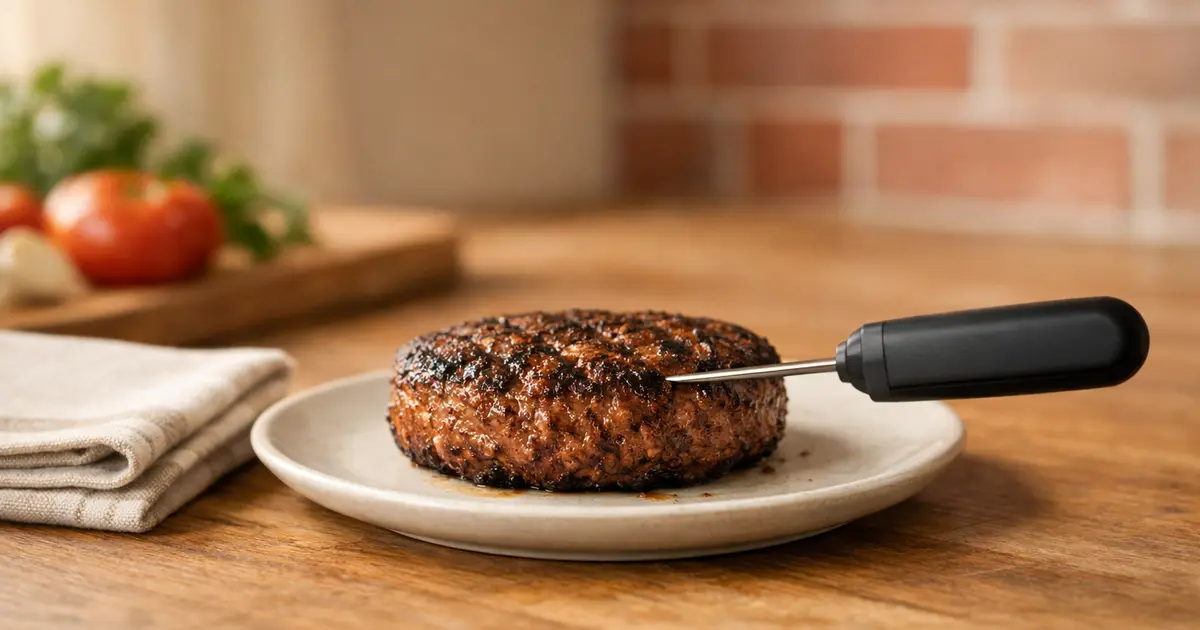
- Burgers, sausages, thin chops and thin chicken breasts. Slide the probe in through the side so the whole sensing area reaches the center. Lifting the item onto a clean plate first saves your fingers.
- Whole poultry. Test the deepest part of a thigh, the deepest part of a wing, and the meatiest spot on the breast. If you stuff the bird, the center of the stuffing must reach the poultry temperature too.
- Poultry pieces. The thickest area, avoiding bone.
- Egg dishes and casseroles. The center of the dish, checked in several places, because hot spots and uneven oven temperatures leave cold pockets.
- Fish. The thickest portion.
A dial model usually needs to go in about 2 to 3 inches, while a digital probe may need much less. Read the maker's directions, or look for the small dimple on the stem that marks where the sensor starts.
Checking accuracy
Most thermometers read within about 2 to 4 degrees F when placed well, but a knock or a drop can throw them off. The ice-water test is the simple check:
- Fill a large glass with ice, add drinking water and stir.
- Put the stem at least 2 inches into the mixture without touching the glass.
- Wait at least 30 seconds and read it without lifting it out. It should show 32 degrees F.
If it is off, adjust the calibration nut if there is one, or replace it. The boiling-water test should give 212 degrees F at sea level, but water boils lower at altitude, so ask your local extension office for the right local number. Wash the probe in hot, soapy water between uses and store it in its sheath.
Why color misleads
Color comes mostly from myoglobin, a muscle protein, and its shade shifts with oxygen, heat, age of the animal and even gases in an oven. So a burger can turn brown before it is safe, and a turkey can stay pink after it is. In a USDA study, 21% of people judged burgers by color or grill marks. FSIS says turkey can stay pink at 165 F, that smoked turkey is always pink, and that grilled poultry can show a rim about one-half inch wide. The reverse also holds: a well-browned casserole top says nothing about its middle.
Worked example
You are roasting a whole chicken that you stuffed. After the timer in the recipe goes off, the skin is deep gold and the juices look clear, so it feels done. Instead of carving, you slide an instant-read probe into the thickest part of the breast and it shows a number below the target, then check the thigh beside the joint and the wing. The thigh is ahead, the breast is behind, and the center of the stuffing lags both. You return the bird to the oven, recheck all of those spots, and carve only when the slowest one, the stuffing, has reached 165 degrees F. The golden skin was never the evidence. The lowest reading was.
Frequently asked questions
Can I leave the probe in while it cooks? Only if it is designed for that, such as an oven cord or wireless model. Others have plastic faces or glass stems that can be damaged by heat.
My burger is pink in the middle. Is that safe? Color cannot answer that. A patty measured with a thermometer at 160 degrees F throughout is safe regardless of color.
What if the thermometer won't calibrate? If the model cannot be adjusted and fails the ice test, replace it.
Related pages: chicken and turkey cooking times and grilling and pan cooking times.
Sources (5)
- USDA FSIS, Food Thermometers fsis.usda.gov
- USDA FSIS, Doneness Versus Safety fsis.usda.gov
- USDA FSIS, The Color of Meat and Poultry fsis.usda.gov
- USDA FSIS, Safe minimum internal temperature chart fsis.usda.gov
- USDA FSIS, Is Pink Turkey Meat Safe? fsis.usda.gov