
LookupA searchable reference table
How to Thaw Food Safely: Fridge, Cold Water and Microwave
Methods, timing, when to cook and refreezing rules from USDA FSIS, including cooking straight from frozen and why the counter is never safe.
On this page
| Method | How long it takes | Cook it when | Refreeze it? |
|---|---|---|---|
| Refrigerator | Large items such as a turkey: at least a day (24 hours) for every 5 pounds of weight. Even a pound of ground meat or boneless chicken breasts needs a full day. | Ground meat, stew meat, poultry and seafood: an additional day or two after thawing. Red meat roasts, chops and steaks: 3 to 5 days. | Yes, without cooking, though there may be some loss of quality. |
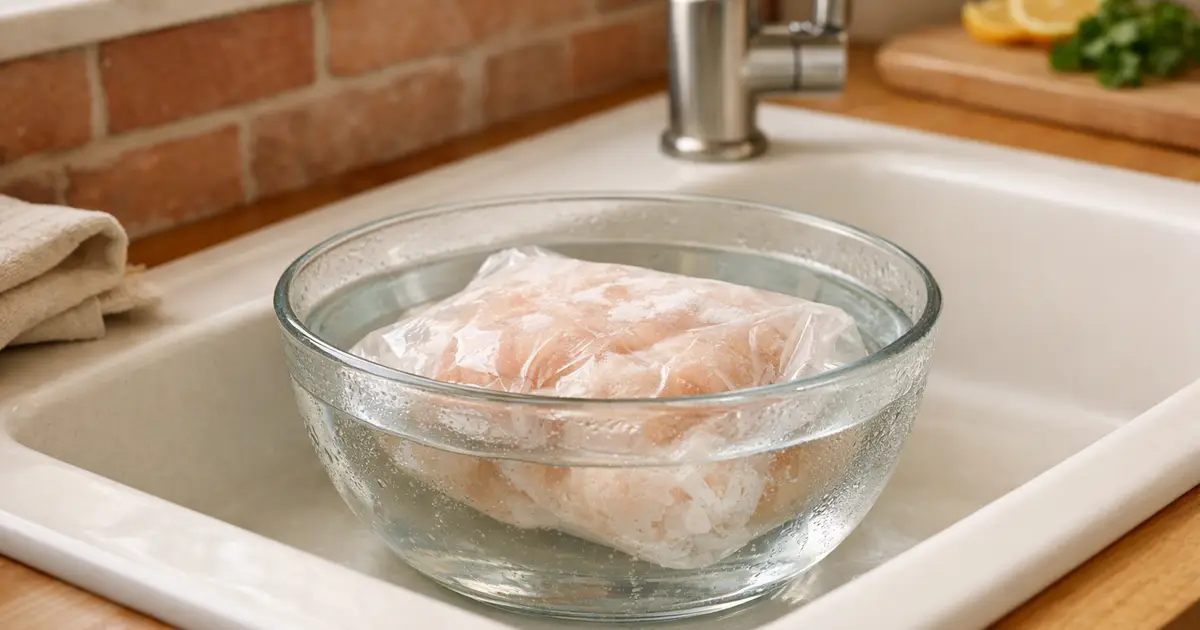
| Cold water: small package | About a pound of meat, poultry or seafood may thaw in an hour or less. Use a leak-proof bag, submerged in cold tap water, and change the water every 30 minutes. | Immediately, if thawed completely. | Cook it before refreezing. |
| Cold water: larger package | A 3- to 4-pound package may take 2 to 3 hours. Whole turkeys: estimate about 30 minutes per pound. | Immediately, if thawed completely. | Cook it before refreezing. |
| Microwave | The page gives no time, because it depends on the food and the oven. | Immediately after thawing, by microwave, conventional oven or grill, because some areas may begin to cook. | Cook it before refreezing. |
| No thawing (cook from frozen) | No waiting. The page says it is safe to cook foods from the frozen state. | Cooking takes approximately 50% longer than the recommended time for fully thawed or fresh meat and poultry. | Not applicable. |
| Never: counter, hot water, garage, basement, car, dishwasher, garbage bag, outdoors, porch | Not safe at any length. Perishable foods must not be left at room temperature for more than two hours. | Do not use these methods. | These methods can leave your foods unsafe to eat. |
What this table covers
The table sets out the safe thawing methods published by FSIS, the USDA's food safety agency, plus cooking from frozen and a row for the methods that are never safe. For each method it gives how long it takes, when you must cook the food afterward, and whether you may refreeze it. Everything is typed from the saved FSIS page, with its figures intact.
If you are in a hurry, the fastest honest answer is that you can cook many foods straight from the freezer. FSIS says that adds about 50% to the recommended time for thawed or fresh meat and poultry.
The safe methods
Refrigerator. This is the best method because the food stays at a safe, constant temperature. It takes planning: a turkey needs at least a day (24 hours) for every 5 pounds of weight. Even a pound of ground meat needs a full day. Refrigerators vary, and a unit set colder takes longer, so FSIS notes a fridge at 35 °F thaws more slowly. After thawing, red meat cuts keep another 3 to 5 days before cooking, while ground meat, poultry and seafood keep an extra day or so.
Cold water. Faster but fussier. Seal the food in a leak-proof bag, submerge it in cold tap water and change the water every 30 minutes. A small package of about a pound may thaw in an hour or less, and a larger package may take 2 to 3 hours. Cook immediately once it is thawed, and do not refreeze it raw.
Microwave. Plan to cook right away, because parts of the food may warm into the danger zone while others stay icy. Do not hold partly cooked food for later.
Why the counter fails
The center of a package may still be frozen while the outside warms into bacteria-friendly territory. That is why FSIS rules out the counter, hot water, a garage, a basement, a car, a dishwasher, a garbage bag, the porch and the outdoors. These methods can leave food unsafe to eat.
Worked example: dinner was supposed to be defrosted
It is late afternoon and the chicken is still hard. You have options. Put the package in a leak-proof bag, submerge it in cold water, set a reminder to change the water, and cook it as soon as it has thawed. Or skip thawing and cook it from frozen, allowing extra time and checking the center with a thermometer. What you do not do is leave it in the sink under warm water. If you thaw it in cold water and then decide not to cook it, the safe course is to cook it anyway and refreeze the cooked food, because the rules say cold-water thawed food should be cooked before refreezing.
Related pages
See the refreezing rules, the freezer storage times chart and the safe internal temperature chart for what to do next. If food sat out too long, throw it away. People who are pregnant, older, very young or immunocompromised should follow their doctor's advice.
Sources
- USDA FSIS, The big thaw: safe defrosting methods fsis.usda.gov
- USDA FSIS, "Danger zone" (40 °F to 140 °F) fsis.usda.gov
- USDA FSIS, Freezing and food safety fsis.usda.gov