
GuideA plain-language guide with a worked example
Microwave cooking safety
Microwaves kill bacteria like any oven, but they heat unevenly. Stir, cover, let food stand and test in several places before you trust a dish.
On this page
A microwave is the quickest way to warm a plate, and it is also the appliance most likely to leave a frozen pocket in the middle of a lasagna. The heat is real, but it is not even. This guide explains where the unevenness comes from and the small habits that make microwaved food reliably safe: stirring, covering, resting, choosing a container and, most of all, measuring.
Why cold spots happen
Microwaves are short radio waves that water, fats and sugars absorb, which makes the molecules vibrate and heat the food. The waves only reach about 1 to 1½ inches into food. In a thicker piece, the center warms by conduction from the outer layers, so it lags behind. Bone can also shield meat from the waves, which is why FSIS suggests deboning large pieces where possible.
The oven's air stays at room temperature, so the surface of the food never browns the way it does in a conventional oven. Do not use color to judge doneness here.
Cover, stir and turn
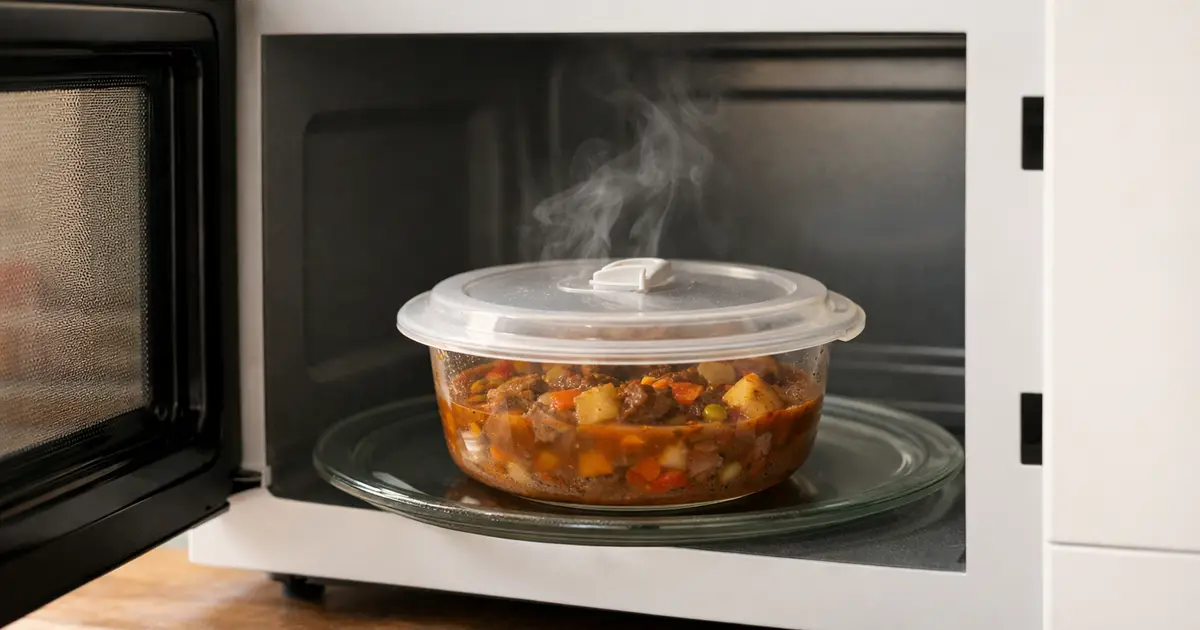
To even out the heat, arrange food in a covered dish and add a little liquid if needed. Use a lid or microwave-safe plastic wrap, leave a gap so the wrap does not touch the food, and vent a corner to let steam out. That moist heat helps destroy bacteria and cook evenly.
Stir, rotate or flip the food partway through. A turntable helps, but FSIS says it is still worth stirring and turning top to bottom. When a label gives a range of time, start with the shortest and add more if the food has not reached its temperature.
Power levels
On high power, the magnetron runs at full capacity. Lower settings cycle it on and off, so medium power (50%) means waves half of the time. FSIS says tender, moist foods suit high power, while eggs, cheese and solid meat toughen there and are better on reduced power. Large cuts of meat belong on medium for longer so heat reaches the center without overcooking the outside.
Wattage matters too: a stronger oven cooks faster, so a recipe's time may be wrong for yours. FSIS describes a time-to-boil test to estimate wattage, and it says to use the minimum time for high-wattage ovens.
Standing time
Cooking does not stop when the beeping does. Molecules keep moving as they slow down, and the food keeps heating. FSIS calls this carryover, resting or standing time, and it is longer in dense foods like a roast than in bread or small vegetables. Allow standing time of at least 3 minutes, then check the temperature. Unless the thermometer is labeled microwave safe, do not leave it in during cooking; use an instant-read model afterward.
Targets from FSIS for microwaved food:
- Ground meats: 160 °F.
- Steaks, chops and roasts of beef, pork, lamb and veal: 145 °F.
- Poultry: 165 °F. Eggs and egg casseroles: 160 °F.
- Reheated leftovers: 165 °F.
See the safe internal temperature chart for other foods.
Thawing, then cooking right away
FSIS recommends the defrost setting, or 30% power. Remove the packaging first, because foam trays and plastic wrap are not heat stable. Turn and rotate the food as it thaws, and with ground meat, scrape off thawed portions as they soften. Some areas may warm and start to cook during thawing, so cook the food immediately afterward, by microwave, oven or grill. Our guide to thawing food safely compares the other methods.
No partial cooking for later
Never partially cook food and store it for later, because bacteria that were not destroyed can keep growing. If you start food in the microwave to finish on the grill or in the oven, move it straight to the second heat source.
Containers and foil
Use cookware made for the microwave. Heatproof glass, glass-ceramic, oven bags and most plain white paper products are fine. Cold storage tubs from margarine or yogurt, foam, brown paper bags, metal pans and take-out boxes with metal handles are not. FSIS says small, smooth pieces of foil can shield wings or drumsticks, but food fully wrapped in foil will not heat and can damage the oven. If you see sparks, stop at once.
Worked example
Wednesday night you reheat a plate of last night's chicken and rice. You scoop it into a glass dish, add a splash of water, cover with a lid set askew and microwave. Halfway through you stir, bringing the cooler middle to the outside.
When it beeps, you rest it for the standing time, then probe in several spots with an instant-read thermometer. The edge reads well above the line, but one spot in the center is lower than 165 °F. You stir, give it more time, rest again and recheck. Only when every spot passes do you eat.
Frequently asked questions
Do microwaves cook from the inside out? No. They only penetrate the outer layer, and the rest warms by conduction.
Can I stuff a whole bird in the microwave? FSIS does not recommend it, because the stuffing may not get hot enough in the short cooking time.
Is a metal-free dish always safe? Not always. Use cookware labeled for the microwave, or test an unlabeled utensil as FSIS describes, and discard any container that warps or melts.
Why did my water erupt after heating? Water in a very clean vessel can overheat past its boiling point without bubbling. Use a bowl with sloping walls, stir, or leave a microwavable spoon in it.
Sources (2)
- USDA FSIS, Cooking with Microwave Ovens fsis.usda.gov
- USDA FSIS, The big thaw: safe defrosting methods fsis.usda.gov