
LookupA searchable reference table
Food Processor vs Blender vs Stick Blender: Which for the Job
Search the job you have, such as soup, smoothies or chopping, to see whether a blender, a stick blender, a food processor or a knife is the better pick and why.
On this page
| Job | Best pick | Why |
|---|---|---|
| Milkshakes, sauces, fruit purées, smoothies and soups | Blender | Extension calls the blender best for liquid foods. |
| Vegetables, meats, crackers and breadcrumbs | Food processor | Extension calls the food processor best for most foods, which takes in the solid ones. |
| Chopping, slicing and shredding before a purée | Food processor | Extension lists chopping, slicing and shredding as a strength of the processor. |
| Puréeing soup right in the pot | Immersion (stick) blender | The blades go into the food in its own pot. |
| Frothing hot chocolate | Immersion (stick) blender | Extension names it alongside soups and smoothies. |
| Crushing ice | Heavy-duty blender | Purdue and UNL both say to buy a heavy-duty model for this job. |
| Smoothies, soups and even nut butter | Blender | Purdue's blender study guide describes the blender as a spinning blade on a motor that can chop, grind, crush, puree and emulsify. |
| Chopping | Not the immersion blender | Purdue's blender study guide says the immersion type is best for blending, not chopping, with limited power. |
| Replacing a full-size blender | Not the immersion blender | It is a complement to a traditional blender, not a replacement. |
| Blending small amounts | Blender with a tapered bottom | Small volumes stay down on the blades; a wide bottom leaves them sitting below the mixing. |
| Quickly cutting fresh produce | Chef's knife | Extension says some tasks go faster with a knife than with a food processor. |
| Cutting fruits, vegetables and herbs by hand | Chef's knife | Purdue's cook's tools handout says the knife is often faster than a food processor. |
| Quickly chopping nuts, fruits and vegetables | Vegetable chopper | A hand chopper is a third option for small chopping jobs. |
What this page compares
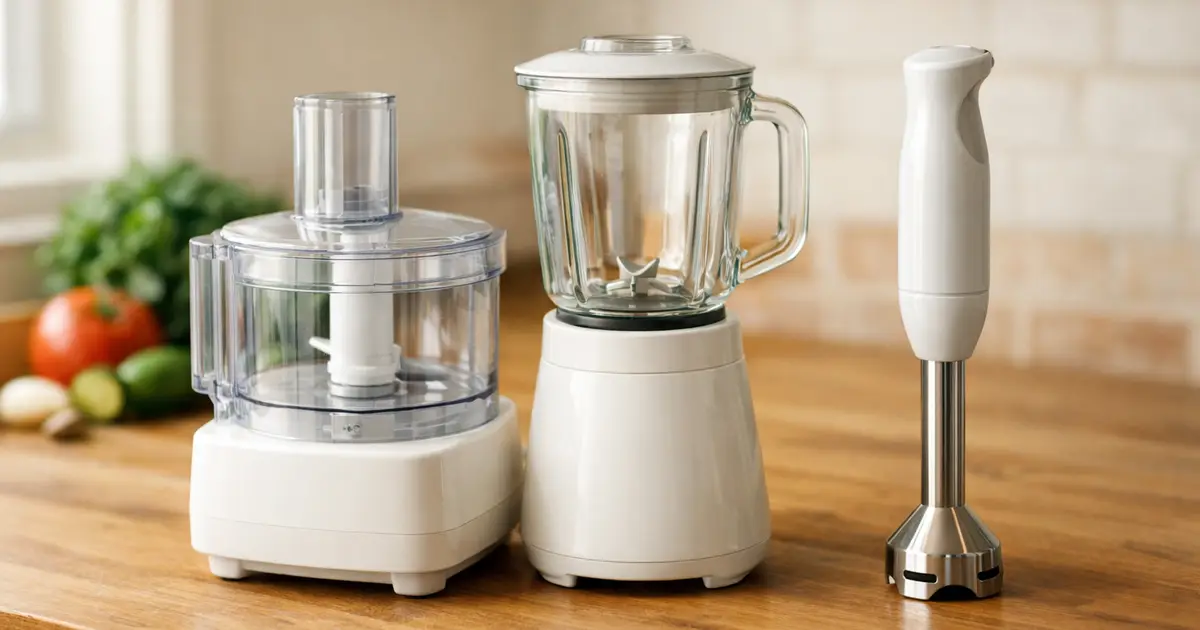
Several appliances get confused all the time: the countertop blender, the immersion blender (also sold as a stick or hand-held blender) and the food processor. Each one cuts food with a spinning blade, yet they are built for different jobs. This page sorts the jobs. Every row in the table is taken from university extension material, and the reason column says in plain words what the source claims. Where the extension guides say nothing, so does this page.
How each one works
A countertop blender is, in Purdue's description, a spinning blade connected to a motor, sitting at the bottom of a tall container. Purdue's blender study guide lists what it can do: chop, grind, crush, puree, emulsify and pulverize. The container shape matters. A blender pushes food against the walls, which sends it back down onto the blades. If the base is wide and you blend a small amount, the food stays at the bottom and misses that circulation, so Purdue advises a tapered bottom for small volumes.
An immersion blender flips the arrangement. Its exposed blades go down into food in another container, such as a saucepan. Purdue's blender study guide says it has limited power and is best for blending, not chopping, and that it complements a traditional blender rather than replacing one.
The food processor's strength, according to UF/IFAS, is solids. It is listed as best for most foods, including vegetables, meats and crackers or breadcrumbs, and it is good for chopping, slicing and shredding before you purée. The same guide names the blender as best for liquid foods such as milkshakes, sauces, smoothies and soups.
Which one to buy first
The sources do not rank them, so there is no single answer. They do give a way to decide. If most of what you make is soups, smoothies and sauces, the blender is the one UF/IFAS points to. If you mostly purée soup in the pot, UNL's list suggests an immersion blender for that. If you mostly handle vegetables, meat or crumbs, the processor is the pick. Remember that Purdue treats the stick blender as an add-on, not a stand-in.
Safety and the fill limit
Purdue's cook's tools handout gives a general rule for a blender: never fill the container more than about 2/3 full. The same handout favors glass or stainless steel for durability, noting that glass lets you see what you are doing. Purdue's blender study guide adds that a glass container should be thermal shock tested if it will see heat. These sources do not cover blending hot liquids, so check your blender's manual for that.
When a knife is faster
Both Purdue and the University of Nebraska–Lincoln say the same thing: a sharp chef's knife is often faster than a food processor for small cutting jobs. The sources stop there: they give no size or volume at which the processor starts to win, so judge by how much you have to cut.
Worked example: a pot of vegetable soup
The soup is cooked and you want it smooth. With a stick blender, you put the blades into the pot and work through it. That fits UNL's wording about puréeing soups in the pot. With a countertop blender, you would work in batches, keeping each load under the fill limit above. A food processor can chop the vegetables beforehand, as UF/IFAS describes, but for chopping a handful, a knife and board may finish first. If the purée is too thick, UF/IFAS suggests adding small amounts of liquid, hot for cooked foods, and processing again until smooth.
Common questions
Is a stick blender the same as an immersion blender?
Yes. Purdue's cook's tools handout calls it an immersion or hand-held "stick" blender.
Can an immersion blender replace a blender?
Purdue's blender study guide says no: it treats the immersion type as a complement. It has limited power and is best for blending, not chopping.
Can a food processor make smoothies?
The sources assign liquid foods to the blender and most other foods to the processor. For smoothies, soups and milkshakes, follow the blender row.
Do I need a food processor if I have a good knife?
Not always. Extension sources from Purdue and Nebraska say a knife can be faster for some jobs, and they give no size at which a processor wins. Your own volume is the test.
What is the fill limit for a blender?
Purdue's cook's tools handout says never more than about 2/3 full of the container. See the safety section above.
More kitchen help: the ingredient substitution finder, the budget meal planner for soup-heavy weeks, and the air fryer and multi-cooker guide.
Sources
- Purdue Extension 4-H, Consumer decision-making study guide: blenders extension.purdue.edu
- Purdue Extension, Kitchen utensils (cook's tools) extension.purdue.edu
- UF/IFAS Extension, Preparation of puréed foods (FS205) edis.ifas.ufl.edu
- University of Nebraska–Lincoln Extension, Cook's tools: 30 time-saving kitchen tools food.unl.edu