
LookupA searchable reference table
Chicken and Turkey Cooking Times by Cut
See USDA oven times for chicken, turkey parts, duckling and other birds. Every poultry cut must reach the same internal temperature, so the thermometer has the final say.
On this page
| Food | Method | Size | Oven temperature | Time | Safe internal temperature | FoodKeeper tip |
|---|---|---|---|---|---|---|
| Chicken, whole | Oven | 5-7 pounds | 350 °F | 20-30 minutes per pound | 165 °F | Cooking times for poultry are for unstuffed birds. Check the internal temperature in the innermost part of the thigh, innermost part of the wing, and thickest part of the breast. Add 15 to 30 minutes for stuffed birds. Stuffed birds are ready when the internal temperature of stuffing reaches 165°F. |
| Chicken parts, breast halves, bone-in | Oven | 6-8 ounces | 350 °F | 30-40 minutes | 165 °F | – |
| Chicken parts, breast halves, boneless | Oven | 4 ounces | 350 °F | 20-30 minutes | 165 °F | – |
| Chicken parts, legs or thighs | Oven | 4-8 ounces | 350 °F | 40-50 minutes | 165 °F | – |
| Turkey parts, breast halves, bone-in | Oven | Any size | 325 °F | 30-40 minutes | 165 °F | – |
| Turkey parts, breast halves, boneless | Oven | Any size | 325 °F | 20-30 minutes | 165 °F | – |
| Turkey parts, legs or thighs | Oven | Any size | 325 °F | 40-50 minutes | 165 °F | – |
| Duckling, domestic or wild, whole | Oven | Any size | 375 °F | 20 minutes per pound | 165 °F | Check the internal temperature in the innermost part of the thigh, innermost part of the wing, and thickest part of the breast. |
| Goose, domestic or wild, whole | Oven | Any size | 325 °F | 20-25 minutes per pound | 165 °F | Check the internal temperature in the innermost part of the thigh, innermost part of the wing, and thickest part of the breast. |
| Pheasant, young, whole | Oven | 2-3 pounds | 350 °F | 30 minutes per pound | 165 °F | Cooking times for poultry are for unstuffed birds. Check the internal temperature in the innermost part of the thigh, innermost part of the wing, and thickest part of the breast. Add 15 to 30 minutes for stuffed birds. Stuffed birds are ready when the internal temperature of stuffing reaches 165°F. |
| Quail, whole | Oven | Any size | 425 °F | 20 minutes | 165 °F | Cooking times for poultry are for unstuffed birds. Check the internal temperature in the innermost part of the thigh, innermost part of the wing, and thickest part of the breast. Add 15 to 30 minutes for stuffed birds. Stuffed birds are ready when the internal temperature of stuffing reaches 165°F. |
| Capon, whole | Oven | 4-8 pounds | 375 °F | 20-30 minutes per pound | 165 °F | Cooking times for poultry are for unstuffed birds. Check the internal temperature in the innermost part of the thigh, innermost part of the wing, and thickest part of the breast. Add 15 to 30 minutes for stuffed birds. Stuffed birds are ready when the internal temperature of stuffing reaches 165°F. |
| Cornish Hens, whole | Oven | 18-24 ounces | 350 °F | 50-60 minutes | 165 °F | Cooking times for poultry are for unstuffed birds. Check the internal temperature in the innermost part of the thigh, innermost part of the wing, and thickest part of the breast. Add 15 to 30 minutes for stuffed birds. Stuffed birds are ready when the internal temperature of stuffing reaches 165°F. |
What is in the chart and what is not
The table lists the poultry rows from USDA FoodKeeper: whole chicken, chicken and turkey parts, duckling, goose and a few other birds. Each row shows size, oven temperature and time exactly as FoodKeeper has it.
We left out the whole turkey. FoodKeeper gives it a single row that covers every weight from small to very large, and a range that wide cannot tell you much about your particular bird. A better turkey chart is coming. In the meantime, follow the directions on the package, and use the thermometer rules on this page. If you are planning a holiday bird, the Thanksgiving turkey timeline covers thawing and food safety from the other end.
Reading a row
Look for the cut, then the size. Parts are listed by portion, whole birds by weight. "Time" is minutes for parts and minutes per pound for whole birds. FoodKeeper's tips matter here too: its timings are for unstuffed birds, and stuffed birds need extra time. Stuffing is only ready when the stuffing itself reaches the poultry temperature.
Check the thickest part of the breast, the innermost part of the thigh and the innermost part of the wing. If any spot reads low, keep cooking.
What changes the time
Oven accuracy, pan depth, whether the bird started cold and how crowded the pan is all change the clock. Bone-in parts take longer than boneless ones, and a bird that has not fully thawed can stay cold at the center long after the skin looks done.
Worked example: bone-in chicken thighs on a weeknight
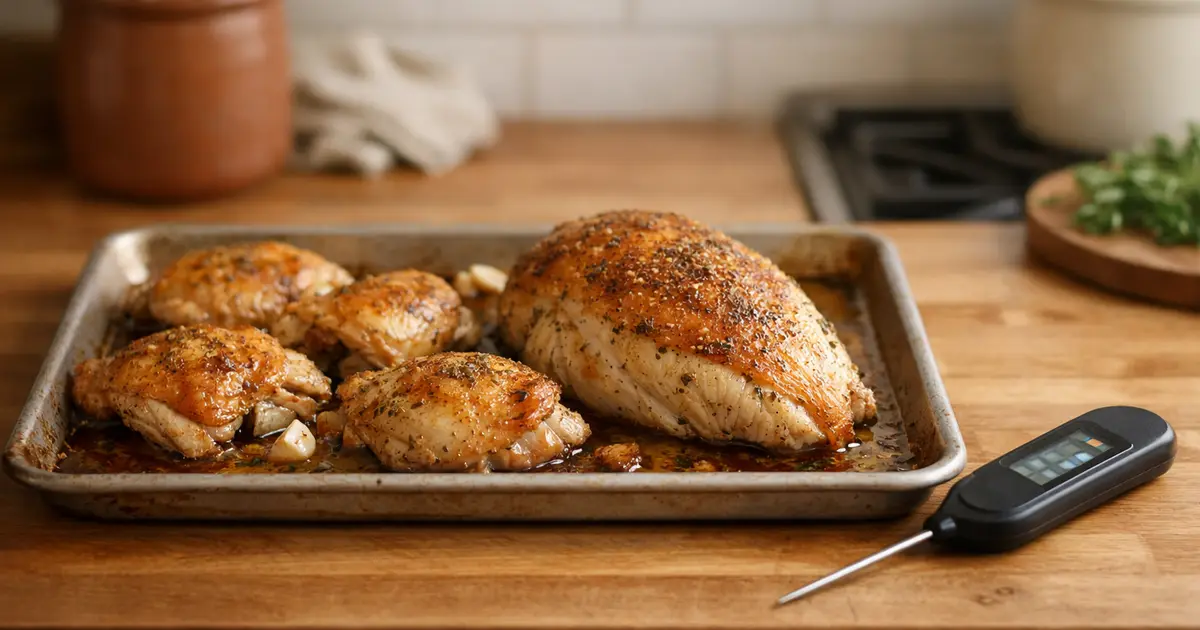
You have bone-in thighs and want dinner on the table soon. Type "thighs" to find the row for legs or thighs, set the oven to the temperature shown and look at the time range. Begin testing at the early end. Insert the thermometer beside, not against, the bone. If it falls short of the poultry line, return the pan to the oven and test again in a few minutes. Juices running clear are not a reliable test, but the thermometer is.
After cooking
Cooked poultry should be refrigerated within 2 hours, in a fridge that holds 40 °F or colder. Eat it within 3 to 4 days, or freeze it at 0 °F, where it stays safe and only the flavor ages. Reheat leftovers to 165 °F. When the timing is unclear, throw it away. If anyone at your table is pregnant, elderly, a small child or immunocompromised, what their doctor says about poultry comes first.
Related: the grilling and pan cooking times for burgers and kabobs, and how long food lasts for raw poultry in the refrigerator.
Sources
- USDA FSIS, FoodKeeper data (version 128) fsis.usda.gov
- USDA FSIS, Safe minimum internal temperature chart fsis.usda.gov
- USDA FSIS, "Danger zone" (40 °F to 140 °F) fsis.usda.gov
- USDA FSIS, Leftovers and food safety fsis.usda.gov
- USDA FSIS, Freezing and food safety fsis.usda.gov