
GuideA plain-language guide with a worked example
Meal planning for a couple: budget, portions and leftovers
Small households pay more per person for food. Plan around a USDA budget, buy family packs only when you will freeze part of them, and turn each dinner into a planned lunch.
On this page
Recipes, coupons and grocery packaging are mostly designed for families. A pair of people cooking at home ends up with half a bag of spinach going limp, a family pack of chicken that is too much for one night, and a casserole that lasts longer than anyone wants to eat it. Planning meals for a couple is less about finding small recipes and more about managing the leftovers on purpose. This guide covers how to set a fair budget for a couple, how to shop and portion, and how long the extra food keeps according to the USDA.
Why groceries cost more per person in a small household
USDA's monthly cost of food report prices a healthy diet for each age and sex group, assuming everyone lives in 4-person households. Per-person costs change with household size, so USDA suggests that a couple add 10% to the combined total, and a person living alone add 20%. If your grocery bill has felt high for just the pair of you, this is part of the reason, and it is built into the official numbers.
Find your weekly figure
Look up each person's line in the latest report, add them, then apply the adjustment. Here are the Thrifty plan lines for a pair of common couples, from the September 2026 report:
| Who | Weekly Thrifty cost, man | Weekly Thrifty cost, woman |
|---|---|---|
| Younger adult couple | $73.60 | $58.60 |
| Couple in their fifties or sixties | $64.90 | $54.60 |
Worked example
Take the younger couple. Add the man's $73.60 to the woman's $58.60 for their combined weekly cost, then add 10% of that sum, the couple's adjustment. The result is the weekly grocery figure USDA's numbers suggest for a thrifty, healthy diet cooked entirely at home. Multiply by the weeks in your budget period if you plan monthly. Our weekly grocery cost lookup lists every age group, as well as the Low-Cost, Moderate-Cost and Liberal plans if you have more room in the budget.
Shop for a pair without wasting half of it
The money a small household loses is mostly in food that goes bad before it is eaten. A few habits help:
- Buy family packs only when you will freeze part of them. Raw chicken or turkey pieces keep just 1 to 2 days in the refrigerator, and raw ground meat 1 to 2 days. Split a large pack into dinner-sized portions as soon as you get home, wrap them well, and freeze what you will not cook in that window. FSIS says it is safe to freeze meat in its original packaging, but overwrap it for long storage to protect quality.
- Freeze while it is still fresh. FSIS advises freezing anything you will not use quickly sooner rather than later, because food frozen at peak quality tastes better after thawing.
- Plan ingredients across meals. If a recipe uses half a bunch of herbs or part of a can of beans, plan a second meal later in the week that uses the rest.
- Keep a short list of freezer basics. Bread, cooked grains, and soups or stews freeze well and let you skip a shopping trip.
Cook once, eat twice
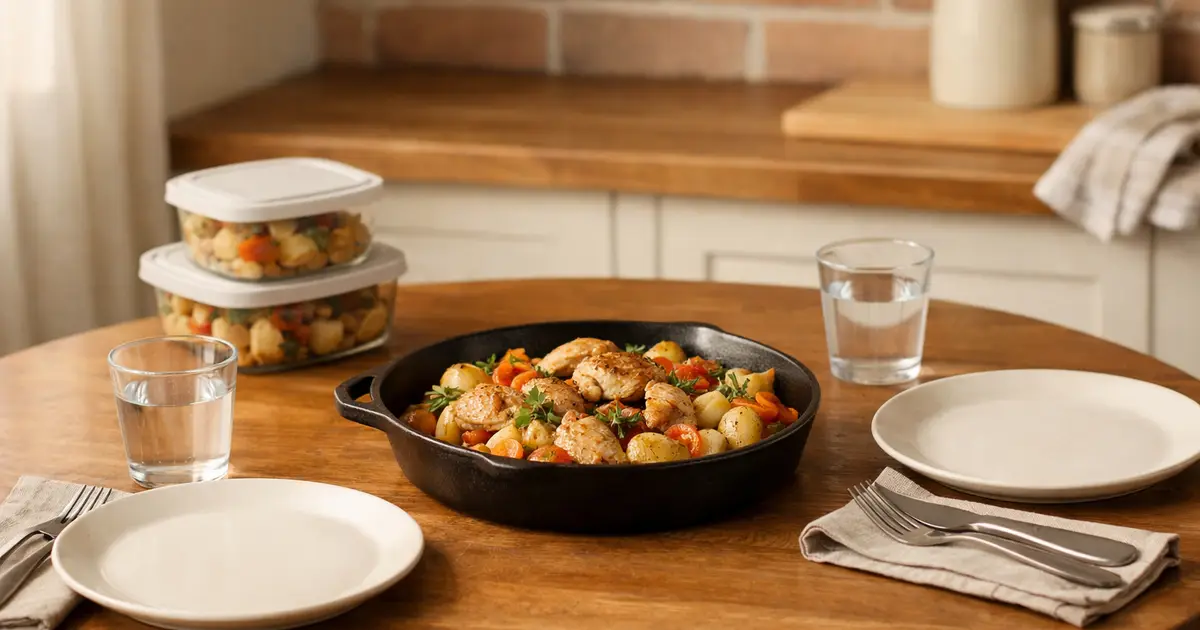
For most couples the easiest plan is to cook a normal recipe and treat the extra servings as planned meals, not as leftovers to deal with later. Decide at the stove where each portion is going.
- Tomorrow's lunch: pack it right away and refrigerate it within 2 hours of cooking. Cooked leftovers keep 3 to 4 days in the refrigerator.
- A dinner later in the month: freeze it the same day. FSIS gives 3 to 4 months as the best-quality window for frozen leftovers, and soups and stews hold up for 2 to 3 months.
- Everything else: if it will not be eaten in the refrigerator window, it belongs in the freezer, not at the back of a shelf.
Small containers help here. FSIS says to divide large amounts of food into shallow containers so they cool fast, and single or double portions do exactly that. Label each one with the dish and the date. When you want it, thaw it in the refrigerator and reheat it to 165° F. Our freezer meal planner covers packing and labeling step by step.
A simple weekly rhythm
- Check the refrigerator and freezer, and use what is already there in the first meals of the week.
- Plan a couple of larger cook-once dinners and a few quick ones, with the lunches they will create.
- Shop from a list, and portion and freeze raw meat on the day you buy it.
- Move tomorrow's frozen meal into the refrigerator each evening.
- At the end of the week, clear out anything past its refrigerator limit.
The weekly meal planner turns this into a checklist you can print. If one of you is pregnant, older or has a weakened immune system, keep to the short side of every storage limit.
Sources (4)
- USDA Food and Nutrition Service, USDA Food Plans: monthly cost of food reports fns.usda.gov
- USDA FSIS, Leftovers and food safety fsis.usda.gov
- USDA FSIS, Freezing and food safety fsis.usda.gov
- FoodSafety.gov, Cold food storage chart foodsafety.gov