
LookupA searchable reference table
Egg Storage and Safety Guide: Refrigeration, Dates and Cooking
Egg storage times, carton dates, refrigeration and cooking rules from USDA FSIS, plus one place the FoodSafety.gov chart disagrees.
On this page
| Egg or egg dish | Time or temperature | Details |
|---|---|---|
| Raw eggs in the shell | Refrigerator: 3 to 5 weeks | Freezer: do not freeze. |
| Raw egg whites | Refrigerator: 2 to 4 days | Freezer: 12 months. |
| Raw egg yolks | Refrigerator: 2 to 4 days | Freezer: yolks do not freeze well. |
| Raw egg accidentally frozen in shell | Use immediately after thawing | Keep frozen; then refrigerate to thaw. If the shell cracked during freezing, discard the egg. |
| Hard-cooked eggs | Refrigerator: 1 week | Freezer: do not freeze. |
| Hard-cooked eggs after cooking | Refrigerate within 2 hours of cooking | Use within a week. |
| Egg substitutes, liquid, unopened | Refrigerator: 10 days | Freezer: do not freeze. |
| Egg substitutes, liquid, unopened (FoodSafety.gov chart) | Refrigerator: 1 week | Freezer: do not freeze. |
| Egg substitutes, liquid, opened | Refrigerator: 3 days | Freezer: do not freeze. |
| Egg substitutes, frozen, unopened | After thawing, 7 days, or refer to Use-By date on carton | Freezer: 12 months. |
| Egg substitutes, frozen, opened | After thawing, 3 days, or refer to Use-By date on carton | Freezer: do not freeze. |
| Casseroles made with eggs | Refrigerator: 3 to 4 days | Freezer: after baking, 2 to 3 months. |
| Eggnog, commercial | Refrigerator: 3 to 5 days | Freezer: 6 months. |
| Eggnog, homemade | Refrigerator: 2 to 4 days | Freezer: do not freeze. |
| Pies, pumpkin or pecan | Refrigerator: 3 to 4 days | Freezer: after baking, 1 to 2 months. |
| Pies, custard and chiffon | Refrigerator: 3 to 4 days | Freezer: do not freeze. |
| Quiche with any kind of filling | Refrigerator: 3 to 4 days | Freezer: after baking, 1 to 2 months. |
| Pickled eggs, opened or home-prepared | Keep refrigerated and use within 7 days | Home canning of pickled eggs is not recommended. |
| Dishes made with raw eggs | Cook immediately, or refrigerate and cook within 24 hours | Cook dishes containing raw eggs immediately or refrigerate and cook within 24 hours. |
| Cooked egg dishes served later | Use within 3 to 4 days | Cool in shallow containers and refrigerate at once. |
| Casseroles and dishes containing eggs, cooking | 160 degrees F | Use a food thermometer to be sure. |
| Eggs and egg dishes, reheating | 165 degrees F | Reheat thoroughly before serving. |
| Refrigerated eggs out of the refrigerator | No more than 2 hours | A cold egg left out at room temperature can sweat, which helps bacteria move into the egg. |
| Dyed hard-cooked eggs | Back in the refrigerator within 2 hours | Use a food-safe coloring. |
| Carton Expiration or Sell By date | No more than 30 days from the packing date | A code date, not a safety date. |
| Carton Use by, Use before or Best before date | May not exceed 45 days including the packing date | A period for best quality. |
| Floating egg | Poor quality, but it may be perfectly safe | Crack it into a bowl and check for an off-odor or unusual appearance. |
| Pink or iridescent egg white | Spoilage | This indicates spoilage due to Pseudomonas bacteria. |
| Washing eggs at home | Not necessary or recommended | Wash water can be sucked into the egg through the pores in the shell. |
What the table holds
The table is built from the federal FSIS page on shell eggs from farm to table: its egg storage chart, its guidance on cartons and dates, and its rules for cooking and handling. Each row quotes the page, with one added comparison row from the FoodSafety.gov cold storage chart, explained below.
Search for the egg product in front of you: raw in the shell, whites, yolks, hard-cooked, liquid substitutes, eggnog, pies, quiche or pickled eggs. Rows near the end cover warning signs such as pink egg white and the floating egg test.
Storage and refrigeration
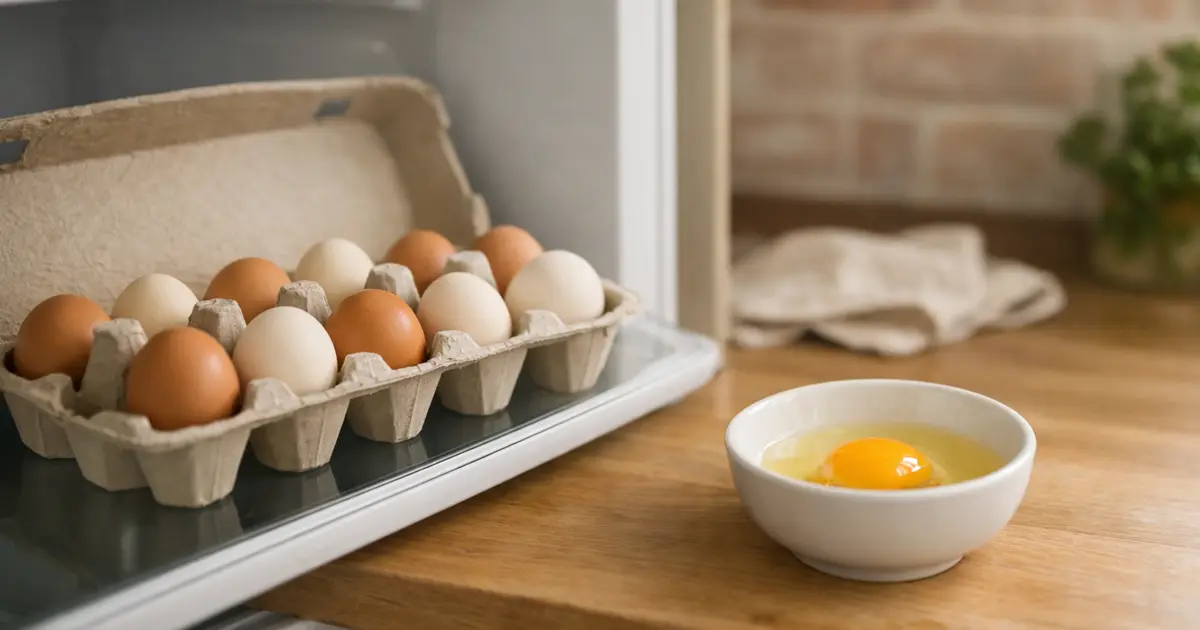
Take eggs straight home and put them in the refrigerator, in their carton, on a shelf rather than in the door where the temperature swings. Raw eggs in the shell keep 3 to 5 weeks in the fridge. Whites freeze well, for up to 12 months of best quality, but yolks do not freeze well on their own and shells must never be frozen.
A cold egg left out at room temperature can sweat, and that moisture helps bacteria move in through the pores. Washing eggs at home is not recommended for the same reason: wash water can be drawn through the shell.
Hard-cooked eggs spoil faster than raw ones because cooking leaves a thin film of water under the shell that suits bacteria. Refrigerate them promptly and use them within the week listed. Eggs hidden and handled in an egg hunt are not recommended for eating.
Dates on cartons
Cartons with the USDA grade shield show a pack date, and any expiration date may run no more than 30 days from packing. "Use by" or "Best before" style dates may not exceed 45 days including the packing date. These are quality windows set by processors. FSIS adds that in-shell eggs that have been pasteurized may be used safely without cooking. See the date label decoder for other labels.
Cooking and reheating
Cook casseroles and egg dishes to 160 degrees F, and reheat leftovers of egg dishes to 165 degrees F. Dishes made with raw eggs should be cooked right away or refrigerated and cooked within 24 hours. Pickled eggs, opened or homemade, are for 7 days in the refrigerator. For the full set of cooking temperatures, see the safe internal temperature chart.
When the agencies differ
For unopened liquid egg substitutes the FSIS egg chart gives 10 days, while the FoodSafety.gov chart gives 1 week. The table shows both. If you want to be cautious, use the shorter limit and check the carton, which may carry its own date.
Worked example: a carton and a quiche
You bring home a carton on Saturday and bake a quiche on Sunday. The carton goes in the coldest part of the fridge, not the door. The quiche is an egg dish, so it should reach the egg-dish temperature in the center, as measured with a food thermometer. Once cooled quickly in a shallow container and refrigerated, the quiche belongs to the quiche row of the table, and it is time-limited from the day it was baked. If you freeze a portion, the freezer note in that row is a quality guide. If a crack or off odor shows up in a raw egg, discard it.
Who should be extra careful
Infants, young children, older adults, pregnant people and anyone with a weakened immune system are particularly vulnerable to Salmonella infections. They should avoid raw or undercooked eggs and follow their doctor's guidance. If an egg is cracked, dirty or has been left out, throw it away rather than gambling on it.
Sources
- USDA FSIS, Shell eggs from farm to table fsis.usda.gov
- FoodSafety.gov, Cold food storage chart foodsafety.gov
- USDA FSIS, "Danger zone" (40 °F to 140 °F) fsis.usda.gov
- USDA FSIS, Freezing and food safety fsis.usda.gov