
TroubleshooterA few questions, then the likely cause and what to change
Moldy Food: Cut It Off or Toss It?
Pick the moldy food and see whether the USDA says to cut off the mold with a wide margin or to throw the item away. This is the guided path; the full table is on its own page.
On this page
Moldy food: cut it off or toss it?
Mold roots can run deep, so the answer depends on how dense and moist the food is. Choose the food and follow the USDA's rule for it.
What is the moldy food?
Cheese
Which kind of cheese is it?
Hard cheese such as Cheddar or Parmesan
Is it a small spot, or is the cheese covered in mold?
Just a small spot or a few
Deal with it soon
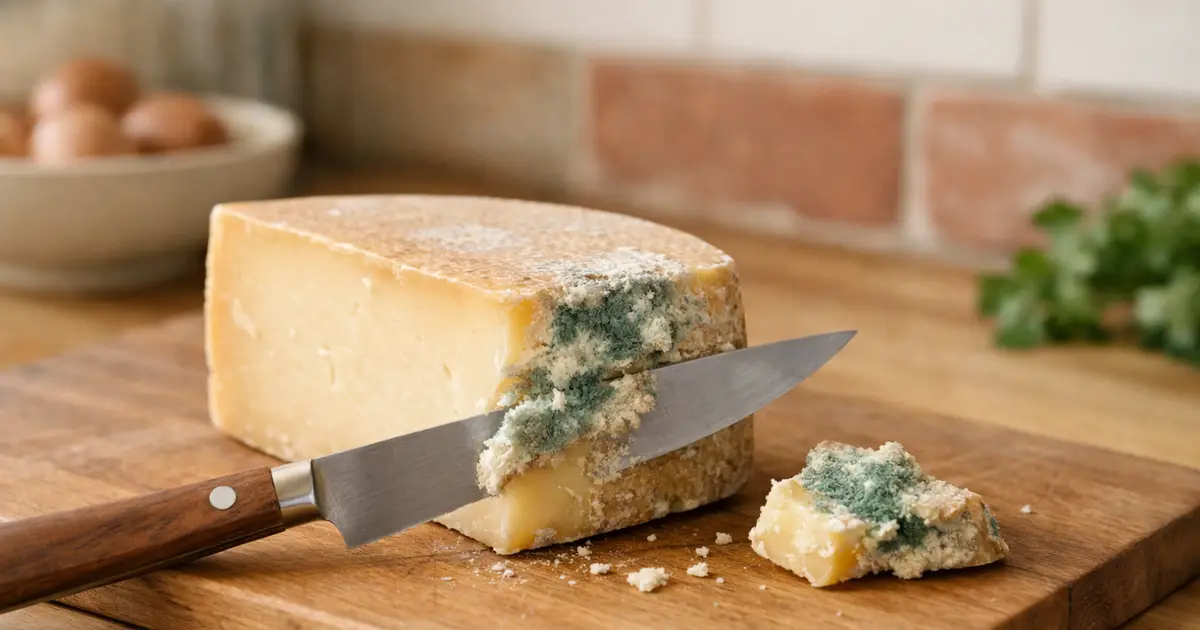
Cut off the mold with a wide margin, then keep the cheese
Hard cheese is dense, and mold generally cannot get deep into it, so a generous cut removes the problem.
What to do
- Cut at least 1 inch around and below the spot, keeping the knife out of the mold itself so it does not carry mold to clean parts.
- Re-cover the cheese in fresh wrap.
- Do not apply this to soft, shredded or sliced cheese.
Covered, or fuzzy all over
Deal with it soon
Throw it away: it is covered in mold
When a food is covered with mold, root threads have already invaded it deeply. Cutting off one spot only works on a dense food with a small patch.
What to do
- Put it in a paper bag or wrap it in plastic, then into a covered trash can children and animals cannot open.
- Clean where it was stored and check anything it touched.
Cheese made with mold: blue, Gorgonzola, Stilton, Brie, Camembert
Is the mold only the kind the cheese is made with, such as blue veins or a white rind?
Extra fuzz of another color, or growth on the inside, is not part of how it was made.
Yes, just its own mold
Keep an eye on it
Eat it: the mold is part of the cheese
Roquefort, blue, Gorgonzola, Stilton, Brie and Camembert are made with safe molds, either throughout or on the surface.
What to do
- Keep it wrapped and refrigerated as you normally would.
- Throw it out if any growth appears that is not the cheese's own.
No, there is other mold on a soft cheese like Brie or Camembert
Deal with it soon
Throw it away: moist cheese can be moldy below the surface
Soft cheeses, and any crumbled, shredded or sliced cheese, hold a lot of moisture, and mold or bacteria can grow below the surface. Shredded and sliced cheese can also be contaminated by the cutting tool. Soft Brie or Camembert with mold that is not part of the recipe goes too.
What to do
- Seal it in a bag or wrap and put it in a covered trash can.
- Clean the shelf and check nearby food.
No, there is other mold on a hard cheese like Gorgonzola or Stilton
Deal with it soon
Cut off the mold with a wide margin, then keep the cheese
Hard cheese is dense, and mold generally cannot get deep into it, so a generous cut removes the problem.
What to do
- Cut at least 1 inch around and below the spot, keeping the knife out of the mold itself so it does not carry mold to clean parts.
- Re-cover the cheese in fresh wrap.
- Do not apply this to soft, shredded or sliced cheese.
Soft, crumbled, shredded or sliced cheese, such as cottage or cream cheese
Deal with it soon
Throw it away: moist cheese can be moldy below the surface
Soft cheeses, and any crumbled, shredded or sliced cheese, hold a lot of moisture, and mold or bacteria can grow below the surface. Shredded and sliced cheese can also be contaminated by the cutting tool. Soft Brie or Camembert with mold that is not part of the recipe goes too.
What to do
- Seal it in a bag or wrap and put it in a covered trash can.
- Clean the shelf and check nearby food.
A fruit or vegetable
What type of fruit or vegetable?
Firm and dense: cabbage, bell peppers, carrots
Is it a small spot, or is the produce covered in mold?
A small spot
Deal with it soon
Cut off the mold with a wide margin, then use the rest
It is difficult for mold to move through dense produce with low moisture, so small spots can be removed from firm fruits and vegetables.
What to do
- Cut at least 1 inch around and below the mold spot, with the knife kept clear of the mold.
- Check any produce stored next to it, since mold spreads quickly among fruits and vegetables.
- Wipe the shelf or drawer where it sat.
Covered, or soft and wet around it
Deal with it soon
Throw it away: it is covered in mold
When a food is covered with mold, root threads have already invaded it deeply. Cutting off one spot only works on a dense food with a small patch.
What to do
- Put it in a paper bag or wrap it in plastic, then into a covered trash can children and animals cannot open.
- Clean where it was stored and check anything it touched.
Soft and moist: cucumbers, peaches, tomatoes
Deal with it soon
Throw it away: soft produce is moist inside
Soft fruits and vegetables with high moisture can be contaminated below the surface, so cutting is not enough.
What to do
- Discard the whole item, and check neighbors for spread.
- Wipe down the spot where it was stored.
Jam or jelly
Deal with it soon
Throw it away: the mold may have made a toxin
In jams and jellies the mold could be producing a mycotoxin. Microbiologists recommend against scooping out the mold and using the rest.
What to do
- Discard the whole jar rather than skimming the top.
- Check the other jars on the same shelf.
Cured or processed meat
Which meat is it?
Hard salami or a dry-cured country ham
Keep an eye on it
Eat it after you scrub the surface mold off
Surface mold is normal on these shelf-stable products. Dry-cured country hams carry it and it must be scrubbed off before cooking. A thin white coating on some salamis is safe, but no other mold should show.
What to do
- Scrub the mold off the surface, then cook or slice it as usual.
- Discard a salami that shows any mold other than its thin white coating.
Luncheon meat, bacon or hot dogs
Deal with it soon
Throw it away: moist cured meats hide mold and bacteria
Luncheon meat, bacon and hot dogs have a high moisture content, so contamination can sit below the surface, and bacteria may be growing along with the mold.
What to do
- Discard the package and wipe the refrigerator shelf.
- Do not rinse or trim and keep the rest.
Cooked food, a spread, bread or nuts
Which of these is it?
Cooked leftovers, casseroles, grains or pasta
Deal with it soon
Throw it away: cooked food with mold is not salvageable
Cooked meat, poultry, casseroles, grains and pasta are moist, so contamination can be below the surface, and bacteria may be growing along with the mold.
What to do
- Discard it without sniffing, and clean the container well.
- Check other leftovers that sat beside it.
Yogurt or sour cream
Deal with it soon
Throw it away: yogurt and sour cream are too moist to trim
High-moisture foods can be contaminated below the surface, and moldy dairy may also have bacteria growing with the mold.
What to do
- Throw out the whole tub, not just the top layer.
- Wipe the shelf with a clean cloth.
Bread or baked goods
Deal with it soon
Throw it away: porous bread and baked goods carry mold inside
Porous foods can be contaminated below the surface, so a clean-looking slice from a moldy loaf is not a safe bet.
What to do
- Discard the whole loaf or package.
- Check the bread box or pantry shelf for spores.
Peanut butter, legumes or nuts
Deal with it soon
Throw it away: foods without preservatives are high risk
Peanut butter, legumes and nuts processed without preservatives are at high risk for mold, and some molds make poisonous mycotoxins in nuts and grains.
What to do
- Discard the whole jar or bag.
- Do not keep the jar for later.
Jam or jelly
Deal with it soon
Throw it away: the mold may have made a toxin
In jams and jellies the mold could be producing a mycotoxin. Microbiologists recommend against scooping out the mold and using the rest.
What to do
- Discard the whole jar rather than skimming the top.
- Check the other jars on the same shelf.
Something else, or I am not sure
Deal with it soon
Toss it: unlisted foods are not worth the risk
USDA's guidance covers specific foods. If yours is not one that clearly allows trimming, the safe ruling is to discard it. Do not sniff it, since breathing in spores can cause trouble.
What to do
- Bag it and throw it out.
- If someone ate it and feels ill, follow your doctor's advice.
What this tool does
Mold is the most common reason people stand in front of the refrigerator wondering whether a cut will fix everything. The answer really does differ by food. Hard cheese and firm vegetables can lose a moldy patch and carry on. Bread, yogurt and jam cannot. This tool asks what the food is and, where it matters, whether the mold is a small spot or a blanket, and then gives the USDA's instruction.
It is a guided path, one question at a time. If you prefer to scan everything at once, the mold on food chart lays out every food and the reasoning in a single table.
Why the type of food decides everything
What you see on the surface is only part of the mold. Thread-like roots can reach deep into a food, and in dangerous molds the poisonous substances often sit in and around those roots. Dense, dry foods slow that growth, so mold has a hard time moving far. Foods with a lot of moisture, or porous foods like bread, give the roots an easy highway.
That is why the cut-off answers always ask for a wide margin: 1 inch around and below the spot, with the knife kept out of the mold so it does not carry spores to clean parts. It is also why jam and jelly are different from a block of Cheddar even though both sit in the same refrigerator.
Special cases the tool handles
Some cheeses are made with mold on purpose. Blue, Roquefort, Gorgonzola, Stilton, Brie and Camembert are safe to eat as they were made. Trouble starts only if a different mold shows up. Dry-cured country ham and hard salami are also expected to carry surface mold, which is scrubbed off.
Safety versus quality
Cutting off mold is a safety decision. Whether the rest of the food still tastes good is a separate question you can answer for yourself. The refrigerator should stay at 40 °F or below, though molds can grow even at that temperature, and food in the freezer at 0 °F will not grow mold at all while it stays frozen.
Worked example: a block of Cheddar and a loaf of bread
You find a fuzzy green patch on the corner of a Cheddar block and a few spots on the heel of a sandwich loaf. Choose cheese, then hard cheese, then a small spot: the tool says to cut. Trim at least 1 inch around and under the patch, wrap the cheese in fresh wrap and wash the knife. For the loaf, choose cooked food, a spread, bread or nuts, then bread: the tool says to throw the whole thing away, because porous foods can be contaminated below the surface.
When to get help
If anyone has eaten food you later found moldy and feels unwell, contact a doctor, especially if that person is pregnant, elderly, very young or has a weakened immune system. Related reading: food left out overnight and how long food lasts.
Sources
- USDA FSIS, Molds on food: are they dangerous? fsis.usda.gov
- USDA FSIS, "Danger zone" (40 °F to 140 °F) fsis.usda.gov
- USDA FSIS, Freezing and food safety fsis.usda.gov