
ChecklistTick as you go, saved in this browser, prints cleanly
Power Outage Food Safety Checklist
Tick through what to do before a storm, while the power is off and after it returns, including how long a refrigerator and freezer hold their cold and what to discard.
On this page
Power outage food safety checklist
Tick items off as you go. The first section is for a calm day before a storm; the rest are for while the power is off and once it returns. Boxes you tick stay on this device only.
0 of 33 done
Before an outage
A little setup keeps food cold for longer.
A thermometer is the only way to know what temperature the food actually reached.
Packed together, foods stay cold longer.
Frozen items stay at a safe temperature longer.
A refrigerator keeps perishable food safe for only 4 hours.
While the power is out
Every opening lets cold air out.
Outside temperatures vary, and food outdoors can meet dirt and animals.
After the power returns
If floodwater reached the kitchen
Sources (3)
- USDA FSIS, Keep your food safe during emergencies fsis.usda.gov
- USDA FSIS, "Danger zone" (40 °F to 140 °F) fsis.usda.gov
- USDA FSIS, Freezing and food safety fsis.usda.gov
What this checklist is for
When the lights go out, the question is not whether the food will warm up but how quickly, and what to do when it does. This checklist breaks the USDA's emergency guidance into steps in the order you will need them. The first section is for a quiet day when a storm is forecast. The second covers the hours the power is off. The third is for the moment it comes back, when the hardest choices happen. A last section covers floodwater.
Your ticks are saved only in this browser, so the list is there if you reload the page. You can also export it as text to paste into a note.
The numbers behind it
Everything here comes from the USDA Food Safety and Inspection Service. Aim for a refrigerator at 40 °F or below and a freezer at 0 °F or below, and use appliance thermometers to check. During an outage, a closed refrigerator keeps food safe for up to 4 hours. A full freezer holds its temperature for approximately 48 hours, and a half-full one for 24 hours. Those figures assume nobody opens the door.
What changes the clock
- Opening the door. Each peek costs you cold air.
- How full the freezer is. A packed freezer stays cold longer than a half-empty one, which is why the checklist suggests filling gaps with frozen jugs of water.
- Where the food sits. Items in the door, at the front, or in thin packages thaw first.
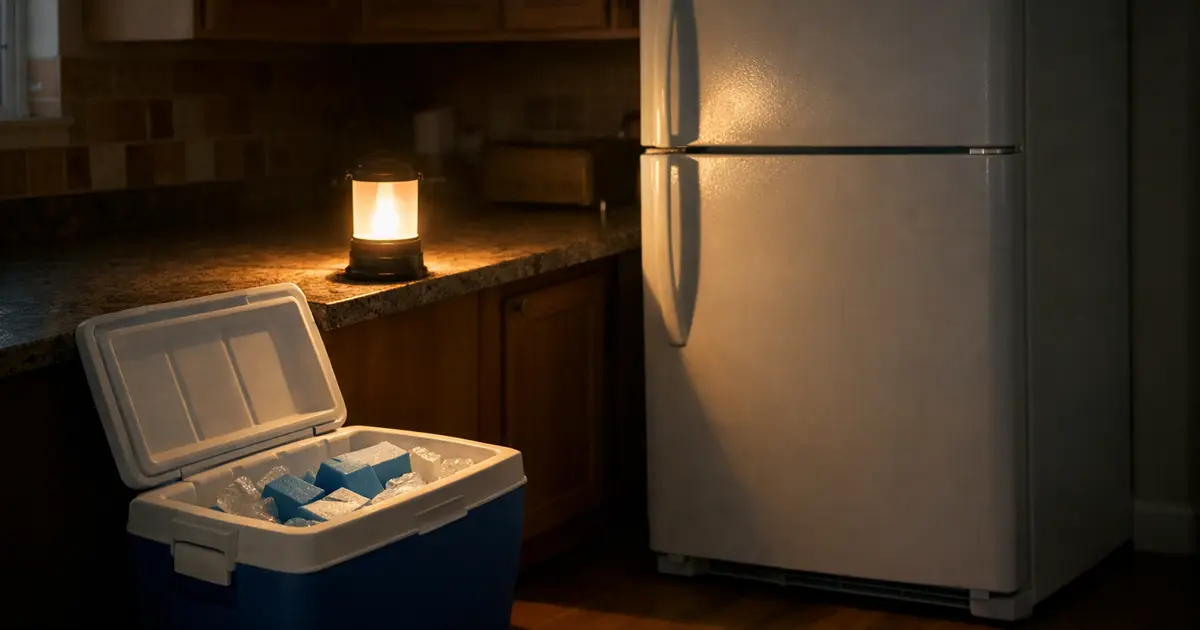
- Ice. A cooler with enough ice, or gel packs, can hold food at 40 °F or below after the refrigerator stops being enough.
Safety versus quality
Everything on the discard list is a safety call, not a taste call. A thawed freezer item that still has ice crystals may be safe but a little mushy. Quality is yours to judge; safety is not. For a full food-by-food ruling after the power returns, see the table of fridge and freezer foods after an outage.
Worked example: a summer storm
A storm knocks the power out at dinnertime on Friday. You write down the time, keep both doors shut and move milk, deli meat and leftovers to a cooler with ice. By Saturday morning the lights are still off and you have passed the refrigerator window, so anything left in the refrigerator, such as the casserole and the cut melon, is discarded when power returns. The freezer, which was full, still has hard food, so you leave it shut. After the power returns, you check the thermometer and sort the freezer food by ice crystals, using the freezer troubleshooter.
When to ask a professional
If a refrigerator or freezer was submerged in floodwater, even partly, it is unsafe and should be discarded. If you are pregnant, older, caring for a young child or immunocompromised, follow your doctor's guidance on any food you are unsure about. Remember: never taste food to find out. If you cannot be sure, discard it.